Showing posts with label food costs. Show all posts

Tuesday, October 25, 2016

As easy as apple . . . sauce!

My friend June made her annual stop at a nearby orchard and brought me a bushel of apples for $16.  This time of year, local apples are abundant and inexpensive (not to mention delicious!).


Applesauce might very well be a sort of a gateway drug for future canners, because applesauce is so easy.  First of all, the ingredients of applesauce are minimal:  apples, plus a tiny bit of water.  Second of all, all the cooking that goes with applesauce happens when the weather is cool, so (unlike in August when the tomatoes and peaches are steaming up my kitchen) heating up a pot of hot apples makes the house feel better, not worse.  And finally, the actual making of the apple sauce is surprisingly simple, especially if you like including the peels in the applesauce (like I do).

The steps of making apple sauce are basic: chop them, heat them, and mash them.  To cut them up, I've used an apple peeler corer in the past, but this year decided just to cut each apple into eighths and then remove the core (triangled wedge).  N-son, with his growing confidence because of his culinary arts training, started on this even before I got home from church, and we worked happily on this together while listening to Chris Thile make his debut as the host of Prairie Home Companion.

We tossed the cut-up pieces into a pot with a small amount of water (about a half-inch, enough to prevent scorching the apples), and then heated up the apples until they got soft.  I used a potato masher, followed by a stick blender that I scored at one of our annual Bad Gift Exchange parties.

At that point, the applesauce was done!  To summarize, all you do is chop them, heat them, and mash them.  No extra ingredients (aside from a bit of water) needed, no special thermometers.  So it's a really quick and easy food to make.

To can the applesauce, you put the applesauce in jars and then boil the jars for 20 minutes (if they're quart jars) or 15 minutes (if they're pint jars).  You'll need actual canning jars and jar grabbers, but that's the only special equipment you need -- you could use a spaghetti pot for canning, if it's deep enough that the jars can be completely underwater.

For us, this past weekend, canning 19 quarts of applesauce took three-and-a-half hours: that's the time from opening up the bags to putting away the freshly-washed pots.  If you start with fewer apples, of course this will take you less time, and there's no reason you need to do so many at once -- you could can just one pint of applesauce if you wanted.

My favorite step-by-step site for canning directions is here.

***
Canning apples was so easy, that I decided to try my hand at making my own apple cider vinegar as well -- this will be my first attempt.  Basically, I just put the apple scraps (cores) in glass jars with water and a bit of sugar, and I'll wait a month or so and vinegar will magically appear.  Or something.  I'm mostly following the directions from the PrairieHomestead site (no relation to Chris Thile, as far as I can tell).  Advice is welcome.  

Saturday, October 3, 2015

Frugal food thoughts

According to Mint, we've spent a lot on groceries recently.  Back in the beginning of September, the program sent me this dire warning:

Now, this $760 (or $437, if you want our "usually") monthly grocery bill is for a household of four hungry people, who almost never eat at restaurants.  And we're not particularly bird-like eaters, either:  when our family cooks potatoes, we cook five pounds at a time, and there's seldom any leftovers hanging around the next morning.  Ah, the joys of teenage-boy appetites!

Mint misses some of our expenses, so the number above is artificially low.  (It doesn't include school-purchased lunches, and it doesn't capture anything I purchase with cash or check, which probably averages out to an additional $100-150 per month).   Still, I think our grocery expenses are low enough to count as "frugal".  Certainly we're down there with what the USDA would call a "thrifty plan".

But although the number of dollars my family spends is one way to measure frugality (the easiest way to measure, and also the most obvious), it's not actually my own personal way of thinking about frugal food shopping.  I've been thinking about this a bunch, lately, in fact.

I've seen four main approaches to frugalling the food budget.
  1. Coupons.  This is the most visible way of pinching food dollars, but I've always avoided it.  I started avoiding it because it was a suck on my own time and energy, but increasingly the reason has become more communitarian:  coupons are a suck on the time and energy of the entire system, because it requires that someone is there to create, promote, process, redeem, monitor, etc. coupons.  Relying on coupons as a regular strategy strikes me as one of those things that looks like it would bring food costs down, but long term drives them up by adding bureaucracy and inefficiency into the works.
  2. Using the efficiencies of the system.  Several of my favorite frugality bloggers love Costco; some even groove to Walmart.  I don't (not that I'm arguing with my favorite bloggers, mind you).   There are a lot of ways that the efficiencies of the system map onto the frugalities I care about, but there are also ways that it doesn't:  here, I'm thinking about how these stores use more packaging than I do, and care less about building up local community than I do. 
  3. Using the inefficiencies of the system.  My husband has become a big fan of this approach; he has taken to dropping into our local salvage store and buying whatever meat is just about to expire, now down to half or 25% of its original price. It's sort of a modern-day, corporate version of gleaning.  As a result, the boys are all reveling in lots more sausages, pork chops, hot dogs, etc than whatever they'd get from me.   (Yuck)
  4. Focus on the food; move out of the system.  Back in mid-August, I spent $60 at a local farmer's market on 44 lbs of peaches ($44), 52 ears of corn ($10), and 18 bell peppers ($6).  The food was in season, locally grown, and went straight from the farmer's wagon into my own buckets and bins.   Later, I spent another $260 at our local Amish market on about 150 pounds of dry goods (flour, oats, nuts, etc.)  The food is now safely put up, and it ought last me through the winter, stored in my own glass jars and (for the flour and oats) old cat liter buckets.  All the packaging and trash I have to show for those big expenditures is a small pile of compostable/recyclable paper bags, a smaller pile of clear plastic bags (sigh), plus one receipt that I think is hilarious in its non-specificity (every item I bought is listed as "grocery").
    $259.33 worth of "grocery", next to the entire amount of packaging from the food.
    I like that my purchases bring me closer to the people who grow my food.  I like that I'm not spending money on advertising campaigns, newspaper inserts, package design, excessive packaging, air conditioning, shopping carts, cross-continental transportation, giant asphalt parking lots, and other things that come with "normal" store-bought foods.   It might not be the most frugal way to buy food measured in dollars alone, but it feels increasingly right to me.

Saturday, September 20, 2014

One way to spend hundreds on groceries

This past month, I spent hundreds of dollars buying meat: I spent about four hundred dollars, in fact.  Especially for a former vegetarian like me, that's a heck of a lot of money to spend on consumable animals!

Of course, the reason I spent so much is that September is the time of year when we rev up our chest freezer for winter use.  Summer, the freezer sits empty and unplugged, but when tomatoes and corn start filling up the pantry, we know it's time to wipe down the inside of the freezer with a bit of water and bleach, plug 'er in, and fill 'er up with food that doesn't make it into canning jars.

My husband and boys are dedicated and enthusiastic carnivores, and they're also prone to impulse purchases.   So when the freezer starts up again,  I try to head off meat purchases that might be expensive/trash-intensive/questionably sourced with my own bulk purchase of hamburger and turkey kielbasa from local, organic places where I won't get styrofoam trays or excessive packaging.  And by bulk purchasing the meat, I bring the price-per-pound down, too.

But as I forked over my money it struck me . . . well, it struck me just how striking it is to pay for all of our hamburger and turkey at once.  This half-freezer-full of animal protein ought to last us for many months.  We'll buy a turkey at Thanksgiving; we'll buy pork for New Years; we might buy chicken wings for the boys' birthdays (a new family tradition), but that might be the only extra meat we buy until March.  So that's something like $16/week for a family of (now) four of us.

$400 for food sounds like a lot of money.  $16 doesn't.  This isn't profound -- it's just another example of how it's possible to think in such different ways about the same amount of money.  It's like the reverse view of that old financial chestnut about adding up the daily coffee purchase or the restaurant lunches:  "that $3/day habit means $750 spent each year on donuts!".  For me, I get my 'yoicks' up front.

I think this is another reason why I like bulk purchasing food.   When I used to shop frequently, every grocery store trip had something unusual to it, so it was hard to get an overall sense of where my money went.   There were just too danged-many purchases to keep track of.  But when I stock up on hamburger, or when I fork over (heh) $500 for  a CSA share that will provide most of our vegetables for the year, or when I take a trip to Miller's and buy enough flour and oats to tide us over for three months, well, then I have a better sense of the heft and expense that goes along with feeding my family.

Tuesday, June 18, 2013

A contrarian view of food waste

It's summer, and here in the verdant rolling hills of Lancaster County where our farms boast the most fertile non-irrigated soil in the nation, thoughts are turning to food waste.  The general consensus:  food waste is terrible.

I'd like to take a contrarian view.  I think that many supposedly-frugal people make much too big a deal of food waste, and that letting food rot isn't necessarily a bad thing.  Not necessarily a bad thing -- but bear with me, here.

It's true that my family doesn't throw away much food.  The food we toss tends to be plant matter -- apple cores, vegetable peels, coffee grounds, the occasional wilted green.  It all goes into the compost bin, where it rots -- just like all the other 146 billion tons of biomass produced each year in the natural world.  When we pull dandelions from our yard, we don't say "dang, we're wasting food!" (even though dandelion greens are edible).   A head of lettuce or a stalk of broccoli doesn't magically become some kind of sacred object merely because it got to spend some time in our fridge.

I'll even go so far as to say the same for meat; animals die in the natural world all the time without being eaten by people.  When I drive by a deer killed at the edge of a highway, I don't think, "man, there goes more wasted food".   Why should I single out a chicken for special "wasted food" status more than, say, a wild duck that met its maker in some fowl accident?

No, when we complain about food waste, the problem is not with the food itself.  In this case, food is a proxy measure for other things that we ought to be paying attention to.  Food is easy to see and measure, just like a child's height is easy for a doctor to measure.  Short kids and tall kids can both be healthy, but a doctor keeps track of a child's height as a proxy for catching problems that might be harder to detect.  In the same way, wasting food tells us that there might be other problems we're facing we need to be aware of.

Let's look at three arguments that people give for not wasting food:  each of these points at a problem that might or might not be fixed by eating that yogurt before it starts sporting those blue fuzzy warts.

1.  People all over the world are starving.
I'm a bit partial to this sentiment, especially considering there's a child we're hoping to adopt from Haiti who has lived through many hungry times himself.  But as any 5-year-old can tell you, you won't feed the hungry people of Haiti (or even of your own city) by shipping a few of your leftovers off to them, nor even by eating less food yourself.

The problem of world hunger is not caused by how much food you buy at the grocery store.  According to Oxfam,
Famine is the “triple failure” of (1) [local] food production, (2) people’s ability to access food and, finally and most crucially (3) in the political response by governments and international donors. Crop failure and poverty leave people vulnerable to starvation – but famine only occurs with political failure. 
In other words, the best way to feed people across the world (or even in your own community) is to donate to or work with organizations that can help to deliver food into the right hands.  Emergency aid helps a lot, and so does help establishing a stable and local food infrastructure.  Advocating for your colleges, restaurants, and groceries to donate excess food to food banks would be a huge help.  Eating those last few bites of cheese before it gets hard, not so much.

2.  Growing, transporting, and selling food takes up vast amounts of our planet's resources.
I agree.  A lot.  In fact, if you want a picture of what I call "waste", look at this:
(How many different ingredients does it take to
make this plastic-encased cake "unmistakably fresh"?)
 or this:
(Organic apples in a bag that will out-last my great grand children).

Even though we ate all the cake, and even though we ate all the apples (well, not the cores), to me THAT is the true picture of food waste.  So much of the food we buy comes wrapped in trash, and we think that's normal.  And the trash that our food comes in isn't even remotely biodegradable; unlike the food that it once covered, it'll be around moldering (but not composting) in landfills for millennia.  THAT is DISGUSTING.  

I'll say that again.  The food we don't eat but put back in the ground turns into dirt that can grow new plants that can feed our world again someday.  Plastic bags and foil wrappers are a one-way trip from "resource" to "garbage".   And that is a true waste, in every sense of the word.

Of course, there are hidden pictures of waste that go with every foil wrapper, plastic bag, and plastic-and-foil-lined-cardboard-juice-container.  Even if we can't see it, we all know about the waste of fuel and fertilizer used in growing and transporting all that food.

The solution to this waste is only partly to consume less food.  The solution, for any ecologically concerned person, also includes trying wherever possible and reasonable to purchase locally grown foods in season.  It involves learning to preserve food (or possibly finding local people who can preserve food for/with you).  It includes choosing foods that are less energy- and ecologically-intensive (such as avoiding processed foods; also possibly increasing the number of plant-based dishes you cook and moving toward meatless or less-meat meals).

The solution also involves paying attention to packaging.  Sometimes, it involves buying in bulk to reduce packaging.  For even more careful people, it means avoiding packaging whenever possible.  Over the years, we've learned places where we can buy milk in glass bottles that we return to the dairy for a refill; our market reuses egg cartons and yogurt containers.  I'm far, far from perfect . . . but I'm proud that as of June 19, our family has put out only 8 trash cans so far this year.

In my eyes, a person in Pennsylvania who buys two bushels of local, organically grown tomatoes in August (using her own buckets as storage containers) and then lets the whole lot rot on the ground . . . that person has created less waste than if she ate every last chunk from a tropical fruit platter encased in plastic and shipped from half-way around the world in January.

3.  Food waste means wasted money.
Okay, now you're talking.  Systematic food waste points to a kind of inefficiency that I really do get twitchy and unhappy about, even though (unlike the two other problems above) it is a problem that affects only the household that's tossing the food.

There are a gazillion techniques for making sure we don't let food go bad, and therefore don't have to make trips to the grocery for even more costly food.  (Here's a particularly pithy set of ideas).  I'll add one technique I haven't seen much elsewhere:
Practice running out of food.  And then, make running out of food part of your normal practice.
Actually, I don't mean running out of all your food -- one of my American-born sons lived through days of food insecurity when he was small, and it still haunts him.  But it's okay to run out of "Easily Spoilable Food A", and then switch to "Long Shelf-Life Food B" until the next grocery run.  For example, I buy a half-gallon of milk each Tuesday, and my kids all know that when that runs out, they switch to water until next Tuesday.  [And if you're worried about their calcium intake, I'll point to the three heads of kale they eat in one sitting, plus all the other leafy green things that scramble into our home from the nearby farms.]  Similarly, when school is out for the summer, I buy a bit of sandwich meat and cheese which goes down early in the week; then we switch to peanut butter or hummus we make from our vast stock of dried beans.

Other ways I make efficient use of food in our home:

Turning old food into new food
The pantry principal
How not to go shopping
My weight in vegetables with no plastic

But these cute little ideas for how to manage the food already in our house, they miss the bigger point.  The takeaway message is this:
Food waste is so bad, but not because of the food.   So the solution to food waste might start by thinking about what's already in our own refrigerators and pantries, but it can't stop there.


Monday, November 26, 2012

131: Gratitude is more than attitude

Thanks to Thanksgiving, we shelled out $136 this week.  We bought cranberries imported from far-away states, a large turkey from our local Turkey Lady, lots of good local dairy products, frozen ice cream and frozen peas from origins unknown.  Probably we bought coffee and certainly someone bought some vitamin water bilge.  The 36-week grocery average continues to hover at  $131/week.

I spent large parts of Thursday cooking, and then I spent more time Thursday and much of Friday "putting up" food.  Getting ready to be thankful together takes a lot of work.  I like doing a lot of work, mind you -- I'm not complaining.  In fact, I'd like to offer this as a sort of a philosophy:
Gratitude is more than attitude.   

My kids get a little grossed out by the sight of the naked, uncooked turkey awaiting its stuffing.  I know they shudder even more at the details of making soup.  It's ooky indeed, I agree, and reason enough to become vegetarian.  But they're not vegetarian; they want to eat meat.  And even back in the day when I myself was vegetarian (but my then-husband was not), it was me who did the soup making.  Because gratitude is more than attitude.  It's being so grateful to this bird who gave up its life, that you're willing to be a little uncomfortable with the ooki-ness.  You appreciate as much of the bird as you can.

Our large turkey made all of these things for our family:
  • A Thanksgiving meal for 8 people (some years, fewer people; most years, many more).
  • Leftover turkey for days.
  • 12 quarts of turkey stock, canned in my borrowed pressure canner.
  • Three shepherds pies.
  • Ooky dinner for the dog.
  • Ooky dog treats (frozen in an ice-cube tray for easy separation).
  • A large pot of Texas Turkey Tomato soup.
And without someone being willing to do the ooky soup part, only the first two items on this list would have been possible.

The last entry on the list (the Texas etc.) was a typical Miser Mom recipe, tossing together a bit of turkey stock, some leftover "Texas barbecue sauce" (hence the name), a bit more leftover tomato sauce that was going nowhere because of the pre-eminence of the rest of the leftovers, a whole bunch of celery that was sitting on the counter whispering "eat me now", and a cup or two of rice just to add body.  Salt and onions got thrown into the mix, too.


 J-son and I taste-tested this recipe at lunch on Saturday, and while we ate it we watched Carole King sing "Turkey Chicken Soup With Rice".  The verdict:  worth singing for.  We nearly--but not quite---finished off the pot with the whole family Sunday night.

It's one thing to stop whining for a little while and spend some air time saying, "I'm grateful for . . . ".  That's a big first step, not only for kids but also for lots of us (um, especially for me).  It's so easy to get caught up in the "It's all so stressful!" mode of thinking, and it's healthy to pause and remember that, after all, Life Is Good.

So, I say I'm grateful for the food on my table.  I say I'm grateful for the people gathered around the table, too.  But you wouldn't much want to hang around with someone who said "I"m grateful for you" and then ignored you.  It would be even worse if that person forgot to check in with you before you got moldy and then tossed you in the compost bin.    (Oops, I guess the people/food analogy doesn't work as well as I thought).   At any rate, checking in on the contents of the fridge and boiling up the last of that beautiful bird is part of the whole "Life is good to me" ritual I want to observe.

And so, I like the effort of Thanksgiving because all that cooking (and more cooking, and then even more cooking) reminds me that actions speak louder than words.  That lip service can be acted out via elbow-grease service.  That paying attention to that turkey on the tray or that celery on the counter -- that using it, and eating it -- is one small way to live out our gratitude.  

Monday, November 19, 2012

$131: School snack saga

N-son came home from school Wednesday and said, "my teacher says I have to bring a bag of potato chips to school on Friday.  We're having a party and I have to bring potato chips."

Call me a horrible mom, but we don't have any potato chips in our home.  Haven't for years.  Call the authorities and report me for abuse, but there it is.  And I'm not about to go out and buy some expensive, processed fat-and-sodium-delivery system that comes in non-compostable wrapping just because my soon-to-be-13-year-old tells me his teacher says I should.  Pencils?  yes.  Paper?  for sure! Potato chips?  No way.

N-son was obviously anticipating that his teacher's say-so was something like a papal dispensation, so he was a bit crestfallen when I delivered the bad news that, no, we were NOT going to go to the store and hunt for salty snacks for his class.  Instead, we looked through our cupboards and whipped up a batch of homemade granola.  I put it in a cardboard container (previously containing grits), that we redecorated with the name "Great Granola".

And then I sent N-son off to school with his granola, and waited to see what happened.

Now, you might love potato chips, and I'm not going to say you shouldn't.  But there are probably things that you do that many other people don't; or else there are things that other people don't do, that you do do . . . and so every once in a while you butt up against popular expectation.  Potato chips are just one of those thing that I don't do, and here was someone who didn't even know me assuming that I'm a normal potato chip person.  But I'm not; I just think they're vile  ---  but that's not the point of the story. The point is that I sent a mildly nervous N-son to school with granola instead of potato chips.  It was a lesson in bucking expectations.  And he wasn't sure what would happen.

And here is what happened:  his teacher loved the granola.  In fact, his teacher had fifths of granola.  In double-fact, N-son called me on my cell phone during the middle of the day to see if we were allowed to leave the container at school so his teacher could have more.  The granola was, in triple-fact, great.

Which goes to show, sticking to our values and sticking to our guns and being just a little bit different from the rest of the world doesn't have to be the end of the world, even for a susceptible almost-13-year old.

****
The flip side of the granola story is that this week turned into a huge grocery shopping week.  We bought more than 100 lbs of food from Millers (50 lbs of regular flour, 10 lbs of rye and wheat flour, 40 lbs of potatoes, 10 lbs of nuts, plus some apples).  From the regular grocery store, we bought coffee, and lots of peanut butter, and a few assorted odds-and-ends.

And, just in case you're feeling too bad for N-son, we also splurged on 3-dozen chicken wings, per his request.  (This was our first chicken purchase in over six months).  We splurged because today is his 13th birthday, and chicken wings was his request for a special birthday dinner meal.  Two of my three older daughters will be back from Virginia to help celebrate.  One of my students who has become close to the family will join us.  As of today, all of my kids are teenagers or older.  I'm feeling just a tad proud and nostalgic.

We spent $223 on food (mixed in with some cleaning supplies) this week.  This brings the 35-week grocery average back up to $131/week.  131 is prime -- indeed, it's a Sophie Germain prime, named after the french mathematician Marie-Sophie Germain, who was, herself, willing to defy societal expectations.  Back during the time that society figured that women couldn't/shouldn't be interested in mathematics, she made huge contributions to an area of mathematics called "number theory", so much so that there are whole sets of numbers named after her.

And I'm guessing (though I don't know this for a fact) that Sophie Germain liked granola, too.


Monday, November 12, 2012

$128: War-n-peacenik

The average food costs in the Miser Mom household continue to fall as predicted.  My guy spent $76 on assorted frivolities (peanut butter, ice cream, and such).  I spent $18 at Market, mostly for dairy products, but also for a bit of splurge on some post-election Pretzel Doughnuts from the Achenbach stand --- Amish donuts are a treat for the kids.  This brings our weekly grocery costs down to $128/week.  

****
The weekend was a weekend of juxtapositions.  Such as, J-son deciding to brush the dog's teeth, and the dog (sort of) allowing this to happen.

Such as, K-daughter, N-son, and J-son performing the closing song at a long evening gala of music at my college.  It was a gala that one of my students put on to raise money for children in Rwanda, a country we hope to visit 3 or 4 years from now.  Most of the evening was GREAT.  My kids were the last of many performers to take the stage, and they . . . well, they were cute.  And not quite professional.  But they got a standing ovation because of the cuteness, and they're still abuzz from that.

I rode the Sudden Painful Death Machine (my new bike) for 15 miles.  Only 97 more miles, and I've got the bike portion of my impending triathalon covered!  So it looks like I'm just about as good on my bike as the kids are at music, but I don't get the standing ovation afterwords.  I'm not as cute, apparently.

Speaking of cute, it was veteran's day this past weekend.  I got to hug a soldier.  And my soldier got to hug a hippie peacenik.  We're good for one another.

Monday, November 5, 2012

$129: More happiness

This past week, we spent $14 on groceries:  my husband bought coffee.  That's it.  It brings our 33-week grocery average to $129/week.

129 (like last week's 132) is a happy number.  If we had 6 fingers instead of 10 --- which, oddly, seems to make a lot of sense to me from a design standpoint -- we'd write 129 as "333" instead.  In base 2, 129 is "10000001".  That's cool.

But $129 (the dollar amount, not the mathematical number) means a lot to me.  I started keeping track of grocery spending last March because I felt in my bones that it was entirely reasonable to spend less than $25 per person per week on groceries.  I felt this, even though I live with (and love) a non-miser husband who purchases a bunch of non-miser-style groceries.
(This week's purchase of coffee, by the way, is something I admit I wholeheartedly approve of.  Mathematicians are machines for turning coffee into theorems, or so said mathematician Alfréd Rényi, and so I do consider coffee to be an essential staple of our home life).
We're entering the months that I expect to be entirely "fringe" spending.  That is, we have vegetables canned up and stored in abundance.  We have meat and cheese and butter in the freezer.  We have pasta and rice set by.  There are beans galore in jars and cans and bags, down in my cellar.  So the only things we need to buy before next spring's growing season comes around are the fringes, the "extras":  dairy products, primarily.  Occasional condiments.  And stuff my husband deems essential.  This week is partial proof of my theory that our spending is going to continue to be low in the months ahead.  And I expect that time will prove me right, and that our weekly grocery average will come down to well under $125/week for our 5 person family.

Time will tell, of course.  But I'd like to think that eating mostly healthful foods (healthful for us, but also supportive of our communities and our planet) doesn't mean spending lots of money.  Rich eating can be a frugal adventure.

Monday, October 29, 2012

133: a Happy number

We spent a heck of a lot of money this week, but not on groceries.  On groceries, we spent only $64:  $8 for eggs and yogurt from market (it's easier to carry eggs and yogurt on a run than a giant stalk of brussels sprouts, in case you were wondering), plus $56 for cereal, coffee, and ice-cream (courtesy of my husband).

This brings our 32-week grocery average to $133/week.  And that's a happy number.

At least, it's a happy number in base 10.  That means, if you square all the digits and add them together, and if you do this over and over again, eventually you get down to "1".  For some reason nobody knows, someone decided to name this property "happy".  Here's how it goes:

133.  Square the digits and add them:  1 + 9 + 9 = 19.
19.  Square the digits and add them:  1 + 81 = 82.
82.  Square the digits and add them:  64 + 4 = 68.
68.  Square the digits and add them:  36 + 64 = 100.
100.  Square the digits and add them:  1 + 0 + 0 = 1.
              Happy?

For us, there's a bit of happiness in knowing the larder is stocked so well that we don't have to go out and get more, even as Hurricane Sandy and the Frankenstorm threaten.  Even when we pre-plan for the upcoming Halloween dinner.  We're set.  We've got what we need.  We have enough, and we don't really need more.  And that's one small part of happiness.

To all my fellow East Coasters, I wish you safe, warm, well-stocked homes that you can hunker down in today.

Monday, October 22, 2012

$135: aimless spending

In a totally abstracted, undirected way, we spent $122 on food this week: garlic, peanuts, candy, yeast, peanut butter.  What's up with that list?

The two most photogenic purchases of the week were the apple machine and the brussels sprouts.
In back, you see the apple peeler/corer/slicer I'd borrowed from my friend June with a now-bent blade.    (Um, June doesn't have a bent blade; the machine does).  June swore up and down she'd never have wanted the peeler/corer/slicer back anyway, but still, I got one [in front] that works.  We'll keep it in my house, and I made June promise she'll come ask me if she wants to borrow it back.  There are few things in life that make me feel as slimy as breaking something that belongs to a friend, even if the friend doesn't want it anymore.  

But wait!  There's more!  As I was lamenting shelling out $45 for a mail-order machine, my pal Judy convinced me I could get a good one via Craigs' List.  And Judy, of course, was right.  So I ended up shelling out only $15 (less money, yay!), and doing the environmentally sounder thing of purchasing used instead of new.  

Speaking of environmental, I decided to combine a shopping trip to market with my long weekend run. I'd meant to pick up just some yeast and a bit of sandwich turkey, but then I fell in love with this stalk of brussels' sprouts.
 [News flash: it's harder to run the last 2 miles home
with a 2-foot tall stalk of brussels sprouts
than without it!]
This week's purchases bring our 31-week grocery average to $135/week.  In base 10, 135 has some semi-photogenic aspects itself.  For example,

and
.
[Thanks to Wikipedia for the photos of those equations].


There is no theme or conclusion to be made here.  Grocery-wise, it was that kind of week.


Monday, October 8, 2012

$137 - Eyes, hearts, and minds

This week, I did a jaunt to Miller's Amish organic grocery to the tune of $64, which paid for 20 lbs of oats and 10lbs of soy flour, plus 4 lbs of cheese, plus . . . well, then plus some pickles and nuts.  I didn't know beforehand that I wanted pickles or nuts, but once I walked into the store I was hungry, so I bought them.  My husband contributed his cereal and our coffee for an additional $41, bringing our weekly total to $105, and our 29-week grocery average to $137/week.

What is in a number?  Shakespeare's sonnet #137 seems to capture the whole idea of our eyes being bigger than our stomachs.  There are things we think we want (oh, those pickles!), and then later we regret spending $6 on a single jar of them.  Here is how Wm. himself said it, in his Sonnet 137.  He says our eyes make us want things that better judgements should know we don't really want.

Thou blind fool Love, what dost thou to mine eyes,
That they behold and see not what they see?
They know what beauty is, see where it lies,
Yet what the best is take the worst to be.
If eyes, corrupt by over-partial looks,
Be anchored in the bay where all men ride,
Why of eyes' falsehood hast thou forgèd hooks,
Whereto the judgment of my heart is tied?
Why should my heart think that a several plot
Which my heart knows the wide world's common place?
Or mine eyes seeing this, say this is not,
To put fair truth upon so foul a face?
     In things right true my heart and eyes have erred,
     And to this false plague are they now transferred.
–William Shakespeare
If we don't want our eyes to lead us into the plague of purchasing pricey pickles (a predicament Peter Piper could have appreciated), maybe we should eat lunch before we go shopping.  Note to self:  eat lunch first; then shop for the pantry.    Or else, I might go nuts.

Monday, October 1, 2012

$138: Swirling around

The weekly grocery average is still $138/week.  Of the $150 we spent on grocery supplies this past week, the heftiest price tag goes to this pile of glass, metal, cardboard, and (sigh) plastic:
I bought 5 dozen canning jars.
(Two dozen were already in use by the time I took this photo).
 I've bought my last set of canning jars for the season.  Or so I say.  The reason for the latest pile of canning jars is the giant pile of apples:  2 bushels for $27 from a local farmer.
1.5 bushels of apples.
(The other half-bushel is hiding in the photo-shy canning jars.)
There were other purchases besides apples and jars:  there are the mushrooms J-son asked for so he can make stroganoff (we're hoping they don't go bad before he can follow through on his promise). There was peanut butter, cereal, and dairy products.   But the apples and the jars, they were the most fun.

Because what's not counted into the totals are all the things I mooched.  Such as, mooching an idea.  Erica at Northwest Edible Life wrote earlier this summer about canning swirly apples, and I fell into apple lust, or at least into swirly apple lust.   I've mooched this idea (although she notes she mooched it from another blogger.  I say we pass the mooching along).
Cutting an apple into thin spirals.

Blanching the apples before canning them.
Next mooch:  my friend June is the one who travels deep into farm and orchard lands here, and she's the one who picked up the apples for me.  ("Are you sure you want two bushels?" she asked.  I have no idea how much a bushel is, but I blustered and said "Yes, of course I'm sure!").  The wagon pictured above holds one-and-a-half bushels.  We're up to our knees in apples.

Next mooch comes in the form of the apple peeler corer itself, which I discovered to my utter joy that my friend June owns.  June is nothing if not a good sharer, and she loaned our family her machine this weekend.  It was even better than I could have hoped.  My kids fell in love.  Swirly apples, fresh off the peeler-corer: they are all the rage.

When we came home from church on Sunday, I announced I was going to start canning apples in earnest.  N-son begged to be allowed to help.  I said yes.  (J-son asked if he could go clean his room -- I kid you not -- and I said yes to that, too).  N-son wielded the peeler-corer nearly solo, to the tune of a dozen quarts and 17 half-pints of apples.

After that, N-son got tired of swirling and he asked for permission to go clean his room.  (Did some alien steal my boys and replace them with pods?  If so, I need to go thank that alien).  I took over and swirled up apples for seven quarts of applesauce (using my yard-sale purchased apple saucer) and one quart of apple juice.  At that point, with another half-bushel of apples to go, the blade bent on the peeler-corer (yoicks).  So I got out my food processor and knife, and I sliced up a bunch of apples to dry.

Yes, I have strainer Lust.
This is the kind I covet.
Two notes on apple equipment: 
1)  I'm going to figure out how to get a new blade for June's peeler corer.  The on-line reviews of her particular machine say this has happened to other people, too, so I'm going to splurge and buy a sturdy beast for myself and my family.  Yes.
2) The apple saucer I bought for cheap at a yard sale -- the kind that's a cone with a wooden pestle -- is gobs and gobs of work, plus I can't seem to get as much of the sauce out of the apples with it as I can with the other strainer (the kind with a crank arm) that I usually borrow (again, from June).  I'm putting my purchase back into circulation; I'm debating buying a machine of my own.  


However, with the apples taken care of, I declare the harvest/preservation season DONE in the Miser Mom household.  Done-done-done. We're finished.  Canning season is over.

Time to stop buying and preserving food, and time to start eating it.  Ahhh!

Monday, September 24, 2012

138: Playing with food

This week, we spent $103 on groceries.  This included a $60 trip to market to get turkey legs and bananas, plus a $43 trip to the regular grocery store for oyster crackers, root beer, and other pirate-inspired foods.

And so, the 27-week average of our grocery spending is $138/week.  138 is not prime (well, clearly it's even), but it is the sum of four consecutive primes:  138 = 29 + 31 + 37 + 41. Cool.

The USDA keeps track of food costs for U.S. households.  (From what I can tell, they don't track actual spending; they put together a list of what would go into nutritious meals prepared at home, and then track the prices of those ingredients).  Their estimate for a  a "thrifty" family of four is $144/week on groceries, while a "liberal" family would spend twice that much.   On the one hand, there is some restaurant spending I haven't kept track of, particularly on the part of my non-miser husband.  On the other hand, we're a family of five, not four, and we  have older kids than in their model.  (J-son alone ought to count for two ordinary people).  Putting the two hands together, I'd think it's safe to say we're in the low-thrifty camp.

But this past week I've been getting little guilt pangs about my food spending.  There's a sense in which we're playing with our food, and I mean that beyond the Pirate/Prime games I have so much fun with.  I spend so little, but its not because I can't afford to spend more.  Going over our recent budget, I realized that there have been months this past summer when we spent more on telephones/cable service than we spent on food -- clearly, we're reveling in luxury. If we were truly hurting for money, the food would stay and the phones would go.  Ditto for many other things in our life:  the second car; the vacation; our theater tickets.

No, I spend so little because it's a game for me.  How can I snag nutritious local food for cheap?  My food game has a set of internal rules:  Local beats shipped-in.  Plain beats processed.  Vegetables beat meat.  Organic beats whatever-you-call-the-opposite.  Mooching food that would have gone into trash cans scores triple points.  Illegal interference if I directly meddle with the husband's grocery fun.   You could call this morals, if you want . . . but that misses a lot of the competitive streak in me.

Truth is, thrift is sort of a game for me.  A game I'm playing while the newspaper rolls in with headlines of millions of kids in this country going hungry.  Of families in Haiti eating mud.  I've followed the blog of Carrie Hetu, who proudly lives a low-income life with an optimism that I can only admire from afar.  And of The Frugal Girl, who wonders why we skimp on watermelons while splurging on designer coffee.

I've found myself wondering, what would happen if I just resolved to spend, say $200 every week on food -- some on my family, and the rest on our local food bank?   What if the money I save on our family food goes not to our own entertainment, but to feeding our neighbors?  The sermon I listened to last Sunday made me think of this even more.  Even if it's true that my own existence can't fix the whole world, it it is still a noble effort to wish my whole existence could be on fixing this world.

I'm not saying that I'll actually follow through on this.  I'm not a saint.  I'm just thinking about what it would be like to try to actually live like one, while instead, I live like me.

Monday, September 17, 2012

$139: new food and used clothes

Grocery spending this week was $250.  Why?  The husband spent $35 of this at grocery stores getting cereal, ice cream, coffee cream, and sundry.  I did a small $17  market run to get milk and yogurt.  And there was also a purchase of $197 for 35 pounds of locally harvested turkey kielbasa.
The kielbasa has, by now, been divvied up into many, smaller bags that have gone into in the pillowcases (sorted by month) in my freezer.  The bulk (so to speak) of our winter meat purchases are behind us.  But watch for the pirate-inspired turkey leg purchases later this week!  

At any rate, the most recent grocery expenditures bring our weekly grocery average to $139/week for 26 weeks.  139 is not only a prime number; it's a rare "twin" prime, coming as it does next to its prime sister (137).  Nobody knows how many twin primes there are.  If you can figure out the answer, you'd be famous forever and earn $1 million.   No, really.

****
But the fall harvest isn't limited to food.  September is a lovely yard sale month in our area.  Saturday I tooled around town for an hour and a half with K-daughter.  For $8.50, I picked up a variety of things I'm happy to include in the Miser Mom household.

This includes not only a bunch of books (one I hope to read on my next trip, one for the boys, and one to give as a gift), but also some spare lasagna pans (so we can make multiple lasagnes and freeze them) and a photo of Dale Earnhardt that will become a gift for a completely devoted N-son.  Also four small cake molds for our halloween dinner and four blue-glass wine bottle stoppers: 
And three pairs of long school pants, plus two pairs of short-sleeved school shirts:
Not to mention a school back pack.  It originally looked fairly tacky because it came with the logo of a tobacco company on it, but the seam ripper fixed it so that it now looks just fine.  N-son has co-opted this.
Plus (not pictured) a reading lamp for J-son.    Not a bad haul for a pile of quarters.  Although, still no long-sleeved shirts.   Sigh.

In the same way that the growing season is producing its last beautiful vegetables right now, the shopping season for household things is going strong but will soon end for me.  I'm taking advantage of these cool, beautiful Saturdays of fall.  Because as we move into October, we switch from buying fresh food to seeing only canned (or imported food) around us.  But the same time, my other shopping options switch from buying used goods (at yard sales) to buying new goods (in stores).   Either way it goes, I'd rather buy things in summer.


Monday, September 10, 2012

135: Variations on a theme

This week, being a little more hectic than I had planned for, I did no grocery shopping whatsoever.  The husband had his own grocery-fest to the tune of $99, bringing home bread and spaghetti and plastic bottles of this-and-that.  I admit I was too distracted to pay attention to the this-and-that.  This brings our grocery average to $135/week for the past 25 weeks -- a new Miser Mom low.  But next week will see a huge bump:  turkey kielbasa arrives on Tuesday.

What is it like to eat in a household where we haven't been doing much shopping?  There's been a variety of very plain dinners, if that even makes sense.  Eggs.  Chili.  One night where we just ate peanut butter sandwiches, with-or-without jelly.

J-son put away the food like the teenage boy he is.  One night, he ate 3 potatoes, a tuna fish sandwich, the leftover spaghetti, and a bowl of soup.  When he asked for ice cream, I suggested he ought to get some vegetables, too.  I'd cooked up a large batch of kale to feed the crew later in the week; maybe he should have some of that?  Too late, he told me.  He'd found it in the fridge earlier in the day and eaten the entire pot of it.  

With the weekend, a bit more sanity arrived . . . or so I thought.  I found, to my surprise, a pair of kielbasa links in the freezer, and so I put them in the fridge to thaw in time for dinner.  But come dinner time, they were the slimiest, limpest sausage links I'd ever seen.  How on earth did that happen?  I spent some time trying to figure out whether the meat was salvageable . . . and finally I realized that the kielbasa was actually a pair of bananas.  Oh.

My vegetable lovers help with the beans.  
On the other hand, when I started getting all our CSA vegetables cooked up and ready to eat for the upcoming week, I had a surprise of a different sort.  The kids begged to be allowed to help.  In fact, I first turned N-son away, but he pouted at not being allowed to snap green beans.  What was I thinking?  We blanched more kale, plus chard and corn and green beans, all in record time.

A variety of plain things.  Every number bigger than 5 (so said Lagrange, a famous mathematician) can be written as the sum of at most four squares.  My new low weekly grocery average would do Lagrange proud.  135 is the smallest number with seven (count 'em, 7!) different ways to write it as the sum of four squares:
  1. 135 = 1*1 + 2*2 + 3*3 + 11*11
  2. 135 = 1*1 + 2*2 + 7*7 + 9*9
  3. 135 = 1*1 + 3*3 + 5*5 + 10*10
  4. 135 = 1*1 + 6*6 + 7*7 +  7*7
  5. 135 = 2*2 + 5*5 + 5*5 + 9*9
  6. 135 = 3*3 + 3*3 + 6*6 + 9*9
  7. 135 = 5*5 + 5*5 + 6*6 + 7*7

Monday, September 3, 2012

$136: reaching new lows

I've been keeping track of grocery spending for 24 weeks -- not quite consecutive weeks, though.  So it surprised me that it's possible at this point to reach a new low average:  $136/week, for 24 weeks.  It could go so low because this week for some reason, we spent only $16 at Market on dairy products and a tiny bit of kielbasa.  And that was that.  
Weekly grocery spending, for 24 weeks.

So the average was the lowest ever (since I've been keeping track).  Go figure.
Average weekly spending, in $/week.

I mentioned last week that I might want to buy kale or other dark leafy greens, but the freezer is full.  The canning jars are almost all in use.  I had had a few empty half-pint jars left, but they got put to service for storing pickled jalapeño peppers from our CSA.  So I'm not going to go buy kale anytime soon.  Probably.  We'll see.

136.  In binary, it's 10001000.  That's pretty cool.  If you line up 136 dollars the right way, you can't get a perfect square, but you can get a nice triangle.


No deep insights -- just sharing my surprise.  

Monday, August 27, 2012

$141: Laying up food for the winter

After 23 weeks of tallying my food expenses, I'm pretty confident in saying that our $194 food bill this past week is above average for the 5 of us; the average is hovering at $141.

We spent money on both what I'd call "short-term" and "long-term" kinds of groceries.  The short-term purchases included $63 at a grocery store to buy commercial vitamin water, bread in plastic bags, processed cereal, etc.,  (not that I would ever judge what my husband buys, mind you).  It also included a $19 trip to our local market for milk in a reusable glass jar, ginger packaged in our own glass jar, apples from a local orchard dumped straight into my market basket, and local cider -- unfortunately in a plastic jug.  (See?  I'm not perfect, either.   On the other hand, I'm so smug, it's a small miracle that my husband can tolerate me).

In a scene of true marital harmony and devotion, my husband made a detour on our long Saturday drive on the way home from visiting C-son -- more details tomorrow -- to take me over to Miller's Amish Store for the first of what I think of as my "long-term" purchases:  $64 for 50 lbs of unbleached flour and 2 lbs of pecan pieces.  From there, I went solo to the southern end of the county and forked over $15 for $25 lbs of peaches, and then -- finally -- bought 3 dozen  more canning jars from our local hardware store.  And with this, the shopping was done.

Earlier this week, I'd moved the canning jars into my shelves, sorted by month.
The pantry is in the red, so to speak.
Wish I had more greens there.
And I defrosted the freezer and sorted all the food into month-based bags before filling it up again.
On top of the freezer:  September, October, butter, and cheese.
This exercise showed me that we still have a few gaps in the bulk summer purchases.  Salsa is on its way, thanks to the garden.  Applesauce will be next; that's also in the plans.  With the shortage of corn this year, I'm not sure how intensely I'll work to stock up this year.

But we're missing leafy green vegetables -- I'm going to have to keep my eyes open for a good deal on kale.  And meat -- I've stocked up 1 pound/week between now and May.  That'd be plenty for me, but my husband will waste away under such a regime, even if I try to fortify him with vitamin water and cereal.  So a visit to the Turkey Lady for a large, large order of turkey kielbasa is in order.  Plus, the Pirate Dinner is on the horizon (ahoy there, matey!), and I want to enlist her help with the menu.   More on that later.

The hope is, if I can stock up on kale and kielbasa, that over the winter we'll pretty much be set for the main part of our meals, and all we'll have to go out to buy will be the short-term kind of stuff.  You know, dairy products and vitamin water.   We'll see how well that plan works out.

Monday, August 20, 2012

$187, $139

Between
   - a short jaunt to market ($22 for dairy stuff and sandwich meats),
   - the peach-picking and tomato-buying escapade ($86), and
   - a grocery store run for shrimp, canning supplies, and ice cream ($79),
we managed to spend $187 on groceries this past week.

The canning supplies -- it floored me that I'd run out.  I had oodles of jars left over from last year.  I'd gotten more canning jars at yard sales. I'd gotten canning jars as Christmas gifts.  I have jars everywhere.  But somehow I managed to buy even more food than I had space for in the jars.  I'd already put up cherries and some pickled zucchini this summer. With the table chest-high with peaches and tomatoes, I somehow managed to run out of jars.  Oh, cripes.

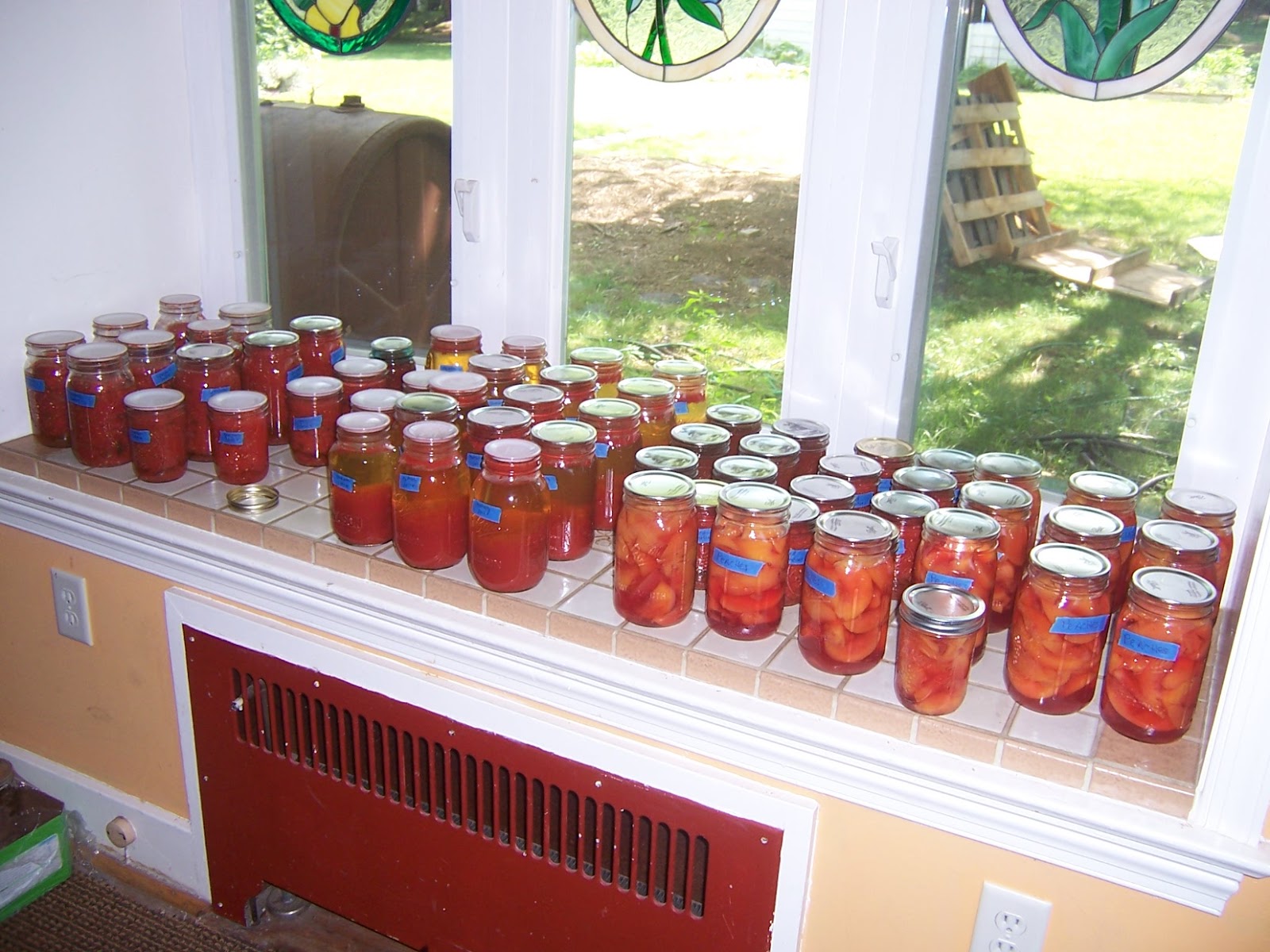
I spent all day Friday and much of Saturday canning and preparing food. It was both exhausting and fulfilling at the same time.  Here's a picture of Friday's work: 38 quarts and 24 pints of catsup, tomato juice, tomato sauce, diced tomatoes, and peaches.


Saturday saw another 10 quarts of peaches and 16 half-pints of pickled peppers (can I say that again?  pints of pickled peppers -- heh).  I also made a gallon of shrimp gumbo inspired by the okra that showed up in our CSA basket.  Cheap okra leads to expensive shrimp purchases . . . go figure.  The gumbo is destined for the freezer, by the way; I'm nervous about canning seafood, plus I'm totally out of jars.  

Even with the expensive shrimp, and even with 3 dozen new canning jars, this is not a bad haul for $187, if I do say so myself.  The shelves are groaning.  

I'm done for now, but I'm not done for good.  The garden tomatoes are coming in gang-busters now.  Their name is salsa.   Apple sauce is in the future.  I'll need more jars yet.  I've become a canning monster, for sure.  I'm loving the chance to buy food in season and to spend my relatively free summers doing cooking, since in the winter I have neither much time nor access to baskets of fresh tomatoes.  

Where does this leave us money-wise?  The weekly average -- not counting those weird restaurant-intensive weeks -- is $139/week, for a total of 22 weeks.  139 is a prime number (in fact, it's a rare "twin prime", coming as it does on the heels of its prime sister, 137).  

Monday, July 23, 2012

$137: salt (the grain thereof)

This past week, we spent $58 on groceries.  If you pretend that the previous  'grocery vacation' week doesn't count (and I do pretend that), then that brings the 20-week grocery average to $137/week.  Again, that '20' (referring to weeks) doesn't count last week.

Spending this week -- which does count again -- consisted of a $7 trip on my part to market (dairy and mushrooms).  It included a $6 trip on my husband's part for ice cream (now all gone), and another $45 trip again by the husband to the grocery store for hamburger buns, more fake bread, and other such items.  This begs the question, what on earth have we been eating?  I mean, aside from ice cream.
C-son is serving up dinner.  Pasta with pesto.  Sauce with lentils.
J-son is serving up a face.
Well, in some small part we have been trying to deplete the stores of food we already have.  Above is C-son, proud of the dinner he cooked:  spaghetti, pesto, and tomato sauce with lentils.  All from the larder of bulk-purchased or pre-frozen CSA foods.  (While C-son makes his own dinner, J-son is making his own face, of course.)  Earlier in the week, J-son made stroganoff with the mushrooms and some bulk-purchased beef.  I experimented with so-so sweet-and-sour soy beans.  It is good to be able to scan the shelves and find dinner waiting, or nearly so.

But the salt needs to have grains taken thereof.  That is, my husband has been feeding the boys restaurant meals on several occasions.  The restaurant meals don't make it into the grocery total.  Cheating.

Also, C-son has lost 9 pounds this past month.  He was skinny even before he lost the weight.  His physician isn't worried, but his mother is.  And probably part of the reason is the unfamiliar, uber-healthy meals we've been having.  So, more recently,  I've started trying to alter the menu to add fat and salt:  omelettes.  hamburgers.  fried potatoes.  Put the pounds back on that boy.

And yet, although C-son has been complaining about vegetables, and although he recently brought up the topic of his eventual adoption party -- and when I asked him what foods he wanted, his first response was a grinned "no vegetables" -- in spite of all that, last night at our hamburger dinner he had thirds on cucumbers, and seconds on green beans, and he asked if in the future we could serve that yellow vegetable again (summer squash), and although he passed up a second hamburger, he finished off the cherry tomatoes.

*****
On the other hand . . . $137/week.  As fake as that number is, 137 is a beautiful number.  Prime, for one thing.  And a pythagorean hypotenuse, for another:  if you walked 88 yards due north, and another 105 yards due east, you'd be 137 yards from where you started, providing you could fly with the crow.

The crow.  Just don't eat it.


Monday, July 16, 2012

$?? -- grocery vacation

This past week was an odd grocery week.  With just two adults in the home, both of us in "let's celebrate the marriage" mode, we didn't do much grocery shopping.   Yogurt?  Bananas?  I think we spent less than $10 on traditional groceries.  But we didn't keep track.

We also ate at a bunch of restaurants.  Plan A was to go to an uber-fancy place recommended by a friend, but when we showed up we discovered it was noisy-chic, not intimate-chic, so we left and went to our favorite sushi place.  That was followed another evening by a local diner, and preceded by a dinner at our favorite sandwich place.  So our restaurant-hopping wasn't as expensive as I'd planned it to be.

But again, I didn't really keep tabs on the total.  Shocking.  Inappropriate.  Call it what you will.  A vacation from the kids, but also a vacation from receipt-gathering.  I figure, once a year, that's okay?

****
Coming up tomorrow:  Cell phones for teenagers. Yoicks!