Showing posts with label trash. Show all posts

Monday, July 13, 2020

Garbage Land, a book I read

Huzzah for little free libraries (both the official ones, and their spin-offs).  With the public libraries closed down, I've been getting a lot of my reading material from these little neighborhood kiosks.  Much of the stuff in these adorable little book-houses is not worth writing about (and some, I put back midway through the book, really).   

But the occasional "click" find makes scouting through these places worth it for me.  I scored big when I picked up Elizabeth Royte's Garbage Land: On the Secret Trail of Trash.  Royte is a journalist who got curious about where her trash goes.  So, she decided to track it all to its final resting place -- a more challenging task than she'd imagined.  This book came out in 2005, so some of it is slightly dated, but it's still quite illuminating.   I was kind of fascinated by the paper recycling chapter: it convinced me, for example, that it's really okay to put the envelopes with those little plastic windows in the "office paper" recycling, because the system automatically floats the plastic pieces out of the slurry, but that wrapping paper is highly problematic.  

Each chapter is a combination of story telling and fact finding.  She tells stories about her own trash, and also about her efforts to meet with the people who deal with her trash -- many of whom are reluctant to open up their practices to an investigative journalist.  Each chapter deals with one aspect of garbage:  Chapter 5 for example, is "Behold this Compost", and chapter nine ("Satan's resin") describes plastic.  

 But even though this is Plastic-free July, I'll just share a passage (pages 32-33)  from the first chapter: "Dark Angels of Detritus". 

Most people don't think of garbage collection as particularly dangerous work.  It may be dirty, boring, and strenuous, but compared to the potential perils of, say, coal mining, the risks of heaving trash seems minor.  In fact, the Bureau of Labor Statistics classifies refuse collection as "high-hazard" work, along with logging, fishing, driving a taxicab, and, yes, mining.  While the fatality rate for all occupations is 4.7 per 100,000 workers,  garbage collectors die at a rate of 46 per 100,000.   In fact , they're approximately three times more likely to be killed on the job than police officers or firefighters.
 
Six days a week New York's Strongest---who along with New York's Finest (the cops) and New York's Bravest (its firefighters) constitute the city's essential uniformed services---operate heavy machinery and heave ten thousand pounds in snow and ice, in scorching heat and driving rain.  Cars and trucks rip past them on narrow streets.  Danger lurks in every sack: sharp metal and broken glass, protruding nails and wire.  And then there are the liquids.  Three New York City san men have been injured and one killed by acid bursting from hoppers.

I've read more recent versions of this -- the New Yorker magazine had a really interesting article on the hazard that garbage collectors face,  adding aspects like rushed timetables and faulty equipment to the long list of daily dangers.  

What is my role in this? Or more specifically, how can I help to minimize the dangers to these anonymous people who clean up after me?  I hope that my efforts to minimize the amount of trash our family produces would help.  I've also taken to heart some of Royte's takeaways, which she describes toward the end of the book as she wraps up (so to speak) her own discoveries during this year of garbage curiosity. 

I'd also begun to act differently around my garbage.  If it started to rain, I tried to run downstairs and cover the cans.  I tied up my cardboard the way Jorge and Jack wanted, and I taped the ends of anything sharp.  I position the trash cans on the sidewalk in a gap between parked cars.  I cultivated a respect for the men and women who almost invisibly whisked it all away . . .  (page 281)


Wednesday, October 24, 2018

The one-year Compost Bin Experiment update

It was a year ago that I took down my old wooden-pallet compost bins and started a metal-fencing system (here's the post where I describe how and why).    And now, a year later, what do I think?  I think, two thumbs up.   Probably green thumbs up, in fact!

If you're as into compost as I am, here's the dirt (heh-heh) on how the first year of a new compost era has gone.

Basically, ever since I moved to this city about a quarter century ago, I've been honing my skills at turning plants into dirt.  I am generally much better at turning plants into dirt than the other way around, in fact (although as the decades pass, I have occasionally had success at the dirt-->plant version of this process).  The basic method for composting is (1) put plants and food scraps on the ground, and (2) wait.  That's about where I was, oh, 25 years ago, and you'd better believe that I was amazed at myself for having my own compost pile.  My three-year-old daughter bragged to my friends, "My mom has a PhD AND a compost pile!".  Yes.

Moving up a notch is having a structure that encloses the pile.  When my husband and I moved to this house, I built two wooden pens out of old fencing.   One pen held the "new scraps" pile, and one pen held the "cooking" pile --- at least in theory, that's how it worked.  Every so often, I'd head out with the pitchfork and "stir" the piles.   But "stir" is in quotes because compost is kinda heavy, so this was a lot more like digging ditches as far as muscle and activity goes.  When the plants-and-food-scraps had sufficiently decomposed---usually after about  a year---I'd  use more muscle to shovel the compost from the piles into a wheelbarrow and move the dirt over to the garden. 

But then my neighbor Morgan ---who has an actual certificate designating her a "Master Composter" --- recommended another method.  This uses portable circles of metal fencing: one circle for the active, lasagna-style pile, and one circle as a holding pen for leaves.  I clip the metal fencing into circles using binder clips, which makes removing the fencing from the dirt as easy as undoing binder clips.    THIS is the method I've been trying out this year, and THIS is a new level of composting awesomeness for me.  I tell you, I'm better than ever at turning plants into dirt now. 
My "active" bin, about three feet in diameter
and three feet tall. 
The compost-makings are about a foot high right now.

This picture on the right is the latest "active" bin, and if you look super carefully, you'll see an almost-empty "holding" bin behind it, with the leaves almost gone.  The bin in front has a bunch of food on top; I'm about to grab leaves from the holding bin and put them on top. 

So, what's great about this system?

First, the layering thing *really* works.  Food and green stuff goes in, and then I toss leaves on top.  More food and/or green stuff goes in, then I toss in another layer of leaves.  I never once stirred this stuff, and yet it happily decomposed down into dirt way more quickly than in the past.

Second, because I put the active bins right there in the garden, I don't have to use a wheelbarrow and muscle to get the compost to the right place.  Once I have dirt, I open up the circle, move the fence to another place, and the compost is right there, in the right place.  I've done this twice now -- twice in one year.   This is really almost like magic here!

A nearly empty bin that used to be full of leaves.
This is about 4 feet in diameter and 3 feet high.  
Third, I really like having a giant bin to hold all those leaves I rake up in the fall.  It's nice thinking of these leaves as "fuel" to add to the top of a pile of food.  Somehow, for my large yard, the ratio worked out beautifully; this holding bin just finally, magically, emptied out right now -- just as fall has started tingeing the leaves that are hanging on the trees in our yard.  We won't start raking again for another few weeks, but when we do, I have empty bins ready to hold those leaves to make the next round of compost. 


No matter what style of compost bins I use, I love the fact that composting reduces the amount of stuff we send to landfills -- less gasoline for garbage trucks, less stuff in the landfill overall.   I also appreciate that, because my food scraps go into the ground instead of the trash can, my garbage doesn't stink.  We can (and do) leave a garbage can in the garage for a couple of months, slowly filling up with stuff from our home, and we don't have to put it out at the curb early because of bad odors. 

Whereas compost piles, in contrast, are happy living places.  Squirrels, birds, and bunnies visit my compost piles more often even than I do.  I really love walking by these bins in the morning and seeing the flurry of activity happening there. 

And that's my October homage to compost bins, with a thank-you to Master Composter Morgan for bumping me up to a new level, for cluing me into the notion that Fence Circles are the new Black Gold. 


Wednesday, June 6, 2018

Trash we don't see, trash we don't recycle.

Here is a scene from the mission where I help serve breakfast once a week.

It's 6 in the morning.  Before the guests come in, the volunteers and workers gather together to pray and eat.  Usually the chefs serve the volunteers, but this past week a new volunteer decides to help serve.  So, I hand my plate over.  "Potatoes, please".  She puts potatoes on my plate.

There is also, as always, oatmeal and also fresh fruit.   Usually, we serve these in styrofoam bowls -- the plates are washable, but washable bowls disappeared years ago (tossed in trash cans?  taken in people's backpacks? not sure), so oatmeal and fruit and such go in styrofoam.

I ask for oatmeal in one of the washable mugs instead of in a styrofoam bowl.  She puts the oatmeal in the mug.  Then I say, "could you put the fruit directly on my plate?"   The volunteer gives me a chipper, "why certainly!", and she puts the styrofoam bowl of fruit right on my plate.

The chef, behind her, intervenes.   "No,  Miser Mom doesn't want a bowl; just put the fruit on her plate".  The volunteer is now bewildered; she looks back and forth between the chef and me.  She wants a bowl of fruit on her plate, but she doesn't want a bowl on her plate . . . ?  The chef takes the ladle, scoops up some fruit, and puts the fruit on my plate.

**

It's scenes like these that remind me how differently I see the world than so many other people do.  Things that are invisible to other people scream out at me.  Trash!  Danger!

So in case you've missed it, I just want to point out another recent story about why recycling is not The Golden Answer to sustainable living.   Recycling is better than sending things to a landfill -- *if* recycling actually happens -- but if you want to be fiscally and ecologically healthy, avoiding the need to dispose of objects is infinitely better than either. 

And here's the latest issue with recycling:  we're starting to face a world in which not only is landfill-bound trash an economic and environmental problem, but so is recycling-bound trash.   In particular,  our main depository for recycling (China) has started refusing to accept our refuse -- see this link, for example.  I've seen this story pop up many times around me in the last few months.  My husband hasn't seen it at all, he tells me.  It's the styrofoam bowl at the rescue mission all over again:  in my face and invisible to others.

Still, I continue to pull a Nancy Reagan, and Just Say No to trash.  Also, to (try to) be gracious and thankful (but firm) when well-intentioned people put trash on my plate.   

Tuesday, January 2, 2018

My top ten trash cans of 2017

So, for some goofy reason I really want to keep track of these numbers, so I'm just going to note for the record that my household put ten trash cans at the curb in 2017.  I'm saying "ten" and "for the record" in the same sentence; but ten isn't a record low for us; the year before this most recent one, we put out only 9 trash cans.   But in 2017, we had another person or two with us during the summer months, and I'm going to blame the trash on that. 

Still, I'm happy that our general trend is still downward. 

In fact, I just figured out how to make a graph in Google Drive and dump it into my blogger (ooh, not hard at all; that's good to know), so here's a visual on our family's trash-can output since 2012, the first year I started counting.

  • 2012:  23 cans
  • 2013: 17 cans
  • 2014: 19 cans
  • 2015:  11 cans
  • 2016: 9 cans
  • 2017: 10 cans

Random facts:  
  • The trash can is a 32-gallon trash can.
  • We don't keep track of the numbers of times we put out our recycling bins.  We don't put a lot of recycling out, either, but I don't bother to count it.  
  • These are the dates we put the cans out:  Jan 31, Mar 21, May 16, Jun 12, July 5 , July 25, Aug 14,  Sep 5, Sep 26, Nov 28.  K-daughter and A-child were with us from May through September, and you can see that the trash picked up (so to speak) then.  
  • From what I can see, the vast majority of our trash is "soft plastics": things like plastic wrap from food packaging.   There's occasional other weird stuff like diapers from A-child's visits or the cardboard/foil circle that sealed a peanut butter jar.  But mostly, soft plastic from food packages.
Since there are only going to be three of us (or maybe even fewer than that, once N-son heads out for his post-secondary education!), I'm expecting the number of trash cans to dip even lower for 2018.    It'll be a false equivalency, because the people who leave the house will be putting out trash where I can't count it, but I'm still sort of morbidly obsessed by seeing how little trash I can send to the landfill from this house of mine.

. . . and . . . that's all.  End of garbage geek.  


Wednesday, September 13, 2017

Mugging it up for my church

My church does a cool outreach for our community:  an ESL class.  We've been doing this for years, but here the "we" really means "they", because I haven't at all been part of it except for cheering.  (Here's me cheering:  Yay!  Go, church!)

One of the actual volunteers with the ESL classes is a follower of this blog who has started an awesome sustainability Facebook page.  Because of this, she and I got into an extended e-conversation about recycling styrofoam*, and in the course of this conversation, I learned that our ESL program uses styrofoam cups.   This is horror.  This is dreadful.

* The UPS Store near us recycles styrofoam packing peanuts, 
but not other kinds of styrofoam. 
There is a Dart Container company "near" us 
(depending on your definition of "near") 
that recycles other shapes of styrofoam.

At any rate, even if it gets recycled, styrofoam is a horrible burden on our fragile planet.  So I decided to buy reusable cups for my church. My Miser Mom Grasshopper (she of the ESL volunteer/Sustainability page persuasion) has already volunteered to be the one to wash the cups each week, so that helped to make the decision to spring for cups an easy one for me.  (Someone else is washing the dishes!  Fantastic!)    

Another aspect making my decision even easier is that an electronic accounting glitch canceled my August donation to my church, so I felt like I "owed" some money anyway, and why the heck not donate the money in the form of reusable mugs?

At any rate, I did a search at my newly-beloved Restaurant Store, and found some 8 oz melamine mugs that look nice and are semi-stackable.  Here's a photo of some of them after they arrived -- I think they really do look good!


Cost:
I ordered 9 dozen (108 cups) for about $240 (that includes shipping).  How does this compare to the price of the styrofoam cups?  At first glance, bill for the mugs seems like a huge expense:  it's possible to get 1000 styrofoam cups for only about $40.  But if my ESL group uses 100 cups a week (which is about what we do right now), and if they meet about 30 times per year (which is about how often they meet right now), then these cups should recover their cost in only 2 years.  That's not a bad ROI, really.

108 UPC codes on 108 stickers,
now no longer on the cups.
Stickers:
Oooh, I want to share something about removing stickers!   Because in spite of me ordering these babies bulk, EVERY one of these cups came with a UPC sticker attached.  At first, when I started peeling the stickers off, I got a lot of gummy residue and had to spend a bit of time picking and picking to get it off.  But then I remembered that heat helps to loosen glue --- and the microwave is a great tool for adding a bit of heat.  For example, when the charity envelopes that I save for about a year get gummy, 15 seconds in the microwave helps to "steam" them so I can carefully peel them open again.  So I resorted to putting batches of a dozen cups in the microwave for about a minute, and when I took them out, I could peel the stickers off with almost no resistance.  Lovely!


Storage:
Because my church doesn't have a dishwasher, we need a way for my Grasshopper to transport the mugs between the church and her home.  There are probably better long-term solutions than the one I came up with, but I sort of like this as a first-attempt:  a canvas beach bag that I snagged from a "free" pile after my neighborhood's summer yard sale.


Bonus: stackable toys
Each set of a dozen mugs came in a little cardboard box, somewhat larger than the size of a brick.  These boxes make excellent stacking toys, and my granddaughter A-child has delighted in making towers that she can knock down with abandon, endangering no one in the process.  So it turns out that if you buy 108 cups, you get a construction set for free.  Awesome.
Prewash demonstrates her burgeoning "sit. stay." skills
next to the tower of stackable cardboard boxes. 


Wednesday, April 19, 2017

Garbage offsets

This post isn't about tomatoes.  Still, I want to show you how happy my tomatoes are, enjoying their recent field trip outdoors.
Tomatoes in the sunshine.
I've started them in canning jars, per my usual custom, because (a) I don't want to spend money on plastic starter trays, and (b) plastic starter trays are so small that they require up-potting the plants anyway and (c) I already have gobs of canning jars just sitting around, and (d) this hasn't resulted in tomato genocide in past years, so I figure why the heck not stick with what's worked?

In the same way that I'm too cheap to buy plastic starter trays, I'm also too cheap to get grow lights, and even when I borrowed grow lights, I was too cheap to leave them turned on.  (Sometimes it's hard being a Miser Mom; I get a little too wound up about leaving on the lights).   But my high-E windows mean that my tomatoes languish without additional help, making the transfer from jars to the ground problematic, unless I give them a way to get full-spectrum light.  So during April and early May, whenever the weather is warm enough, I take my tomatoes outdoors to play during the day, and then bring them back in at night to protect them from cold and/or rain.
The tomatoes in their new "school bus",
hanging out with the violets.
What's different this year is that these field trips have a new tomato school bus, so to speak. Instead of carrying my tomato-canning-jars around in their cardboard boxes (a dozen to a box), I now have a fantastic wooden basket with handles that just perfectly fits all two dozen jars. This box is a most excellent acquisition, because not only does this box allow me to carry all the jars out (or back in) in one trip, but it also means I don't have to worry that errant rain will destroy my storage boxes by making them soggy. I love my new tomato school bus.

And where, you might ask, did I get this wonderful box?

From my neighbor's trash pile.


My neighbors, they throw away such amazing stuff.  Here I am, agonizing over two tortilla bags that go with feeding 8 people at our family's annual money dinner (internal monologue: "Is there  any way I can buy green tortillas around here without plastic bags?"  fret, fret, fret . .  ).  I obsess over eliminating material that is designed exclusively for the purpose of being disposed of.  And my neighbors, their trash piles contain object after object that remains perfectly useful . . . just not useful to my neighbors.  I've rescued I-don't-know-how-many beautiful wicker baskets, art canvases, flower pots, pieces of furniture, children's toys.   Just the other day, I pulled out a tea kettle.

This gets me steamed.
The kettle is in perfect condition.  But my neighbors are renovating their kitchen, and apparently the kettle no longer fits the decor.  I admit I don't need a kettle either, but I couldn't bear the thought of this thing taking up space in our increasingly overflowing landfill, so I grabbed it off the top of their trash pile and added it to our "donate" box.

To be more specific, I added it to our "donate -- household goods" box.  We have donation boxes for household goods, for clothes, for books, for scrap metal, for rags, and for arts and crafts, all near our garbage can, which is slowly-but-surely filling up for the third time this year.  I saw the level in my own garbage can rising even as I rescued the tea kettle from my neighbor's garbage, and a thought struck me.

If companies (and even individuals) can buy carbon offsets from other sources to make up for their own excesses, maybe I could use garbage offsets to make up for my own landfill contributions.  What would happen if, for every garbage can my family produces, I rescued an equal amount of perfectly good stuff and got it into the hands of people who could use it?  My net effect on the local landfills could be zero, even if I'm not technically zero waste myself.

I want to be clear that I know I sound like a zealot and/or crazy person saying all this. I don't actually root around in other people's garbage cans, and I'm not about to start doing that now, nor in the future.  (I've only rescued the stuff in plain sight, left on the top of the can or on the ground next to it).  I don't actually want to structure my life around being the Don Quixote of Garbage, riding off to tilt at trash cans every garbage day.

And yet, the idea of having a net-zero effect on our landfill appeals to me.  If I can't quite figure out how to avoid the tortilla bags and other soft plastics that seem to make up the bulk of our garbage, maybe I can help see to it that our garbage has a little less companionship as it heads off to its final resting place.

It's something to think about.

Wednesday, April 5, 2017

Wading ankle deep

Sometimes, when you start seeing something it's hard to un-see it again.

On the one hand, back in the days that I was house hunting, I became super-sensitive to the "For Sale" signs in front of houses, but once I bought a house, I quickly learned to ignore those signs again.  So there are things I've learned to un-see after seeing them.

But somehow, this spring, as the snow melts and the sun begins to shine, I see trash everywhere.  I want to see the crocuses, and the daffodils, and the amazing blue skies, and the buds on trees.  But instead I see plastic bags and bottles, candy wrappers, stray paper.  I drove my students to a math conference last weekend, and the whole long drive through our region's rolling farmland, I saw litter lining the roadway.  I can't un-see it anymore.

plastic bag in the grass

The first time I remember being sort of rocked back by roadside trash was in Haiti, which my husband and I visited back in 2011.  The environmental trash there is really astounding; it's everywhere.  People sell drinks and food along the roadways, propping their tables along sidewalks next to gutters full of piles of trash.  The garbage there is like music and advertisements at the mall -- it's so ubiquitous people don't even seem to notice it unless (like me) they're strangers to the experience.  In fact, the mall drives me bonkers in the same way the streets of Haiti did (or maybe even worse, actually, because I really detest the mall).
Styrofoam block in the bushes

In the same way, I remember being somewhat amused and impressed by Bea Johnson (writer of the Zero Waste Home blog) and her excursions to pick up trash at her nearby beach. Surely this is a Sisyphean task because the giant ocean keeps bringing in new waves of plastic and other detritus.  It was probably shortly after reading that post that I ran a marathon with one of my running buddies, slogging our way through miles and miles of nearby Amish farmland.  And it was on that long run that I realized that it's not just beaches that have garbage washing up on its shores -- it's, like, everywhere.  There's trash washing up on the shores of Amish farms, just like it washes up on the shores of our beaches.  
white plastic rings and black plastic lids in another yard
How did this trash just pile up all around me without me ever noticing it?  Am I like the frog in that gradually warming pot that never realized the ever-increasing danger around me?  Or has my world always been like this, and I've just become so garbage-obsessed that I never noticed it before?  Is it the world, or is it just me?
This plastic ring is not a crocus.

I used to think that litter was caused by litterers: the jerks who threw their soda cans out the car window.  Litter, my teen-age self believed, was a deliberate act.  But now I see litter as a structural problem, caused by a society overrun by excess.   When we buy fast food, it comes with so many varied pieces of trash -- straws and their wrappers, condiment containers, the plastic bag containing napkins and plastic forks and bags of salt and pepper -- that it's all to easy too accidentally drop some of this trash as we walk from one place to another.  Trash overflows the cans that line the streets of my neighborhood, and because of that overflow, some of the trash escapes on the wind.  Trash haulers do the unenviable job of pouring garbage from one container to another, and --- like any of us --- they spill a fraction of this, which escapes yet again. It's no surprise, since we're surrounded by disposable objects, that we have a disposal problem.

I know there are other problems more urgent and pressing.  The impending famine that 20 million people across our globe will soon be facing is much more terrible, much more urgent, than roadside garbage on American highways and byways.  I also know that I can't do much on my own about either problem -- I can't feed people in war-torn countries, and I can't stem the tide of senseless plastic filth that permeates my landscape.

Still, it needs to be said.  We're living ankle-deep in our own trash.  Maybe we could try to change our society so that we focus on creating things of lasting value, and start to avoid creating things that get thrown in the trash, and on the roads, and in our oceans.  And if we can't change our society, at least maybe we could try to change ourselves.


Wednesday, January 4, 2017

Talking Trash (a 2016 wrap-up)

Talkin' Trash again.

One of my mathematical friends came up to me yesterday and said, "I just want you to know that now, every time I put out my garbage can, I think of you."  He paused and then asked, "Does that sound horrible to say?"

I guess it's not as bad as saying, "Every time I see you, I think about my garbage can".

Me giving my BFD talk.
Last summer at the big math meetings, I gave a big talk.  The audience contained what seemed like a gazillion people, but it probably wasn't that many: maybe only half-a-gazillion, or maybe a third of a gazillion people.  It was a BFD talk (that's army-speak for a Big Deal talk), and I spent a lot of time preparing the talk, trying to think of some way to launch the talk that would be interesting and new and also understandable for an audience that contained undergrads and graduate students all the way up through senior mathematicians.  So I started the talk by telling people that the previous year (2015) my family put only 11 trash cans at the curb, and from there I sort of led people into the real subject of the talk, which had to do with teaching math.  But people remembered the trash part best.

So here at the winter math meetings, I have lots of conversations about trash, but for once I'm not the person starting the conversations.  I keep thinking I should compile a list of the surprising questions I get on this subject.  Tonight's question was, "Do you use essential oils?"  I totally love the question one serious person asked, somewhat nervously:  "Do you make all your guests eat all the food on their plates?"   (Then the person added, as if this answered the question, "Well, I guess you compost."  I'm still not sure how the cogs were linked up in that person's mental machinery).

But the truth is, the further along I get into the trash-reduction world of mine, the easier it becomes. It's not just easier to avoid trash, but it's also easier to risk being weird in my pursuit of trash avoidance. Today I  breakfasted on home-packed trail mix (zero trash, more habit than challenge by now).  And then for lunch I went to where a bunch of other math folks were headed: the food court at the mall.  At the sushi stand, the only option for getting a meal was to put the sushi rolls in styrofoam clam-shell containers, and so I nearly turned away sadly to look for alternatives . . . but then I turned back and asked one of the cooks, "Is there a way to get lunch without the styrofoam containers?"  Total weirdo, I know.

My planner bag has a zippered pocket
for my spoon and chopsticks.
The chef was startled at the question, but then asked, "Are you going to eat your meal here?"  I was; he handed me a plate.  I filled it up with my favorite sushi rolls, added the wasabi and soy sauce directly on the plate, had them add the sea weed salad, and paid for my lunch.  Since I already carry my chopsticks in my planner bag  everywhere I go, it was a perfect zero-waste meal.  At one point I thought to myself, "Have you really gone over to the crazy side?  What if *everyone* did that?"  But then I realized that if everyone asked for alternatives to styrofoam, the sushi stand might stop using styrofoam, which would actually be a good thing.  So Trash-Free Lunch plus moral certitude.  I'm tellin' you, I'm becoming one of those people.

And the funny thing is, it's not just me.  Because I walk around these math meetings, and people stop me to tell me that they're carrying their own reusable mug.  Or that they've started being much more anal about recycling.  Or that they didn't hear my talk themselves, but someone told them about it, and it's made them rethink why they get a paper napkin under their water or a paper coaster under their beer, if it's just going to go in the trash anyway.

Even my own kids, who because of my "Don't Drive Them Crazy" rule I've tried very hard not to coerce into my garbage-geekdom, have caught the bug.  The year 2016 was even better for trash avoidance than 2015; this past year we put out only 9 cans.  I was telling J-son this -- my ultra-hip J-son, my cool, don't-make-waves J-son, my Mr. Fashion J-son -- and his response was, "Wow.  We're going to have to work hard so we can beat that for next year!"

So here's looking at 2017, hoping it doesn't get too wasted (in the garbage sense of that word).  I'm not only avoiding putting trash at the curb at my own house, but there are trashcans all around the nation getting less use than they used to.  Maybe I haven't helped to avoid a gazillion trashcans . . . but I'll settle for a third of a gazillion, or even a tenth of a gazillion, for now.

Sunday, August 28, 2016

A web site that I love for frugal reasons

As a person who believes strongly in community, conservation, and frugality, I have been having a lot of fun lurking on local frugal-enabling sites.

One of my most constant lurks is Freecycle.  (Does everyone know what that is nowadays?  It's basically like Craigslist or a local E-bay, except everything offered or asked for is free).

There are ways that Freecycle is a bit overwhelming, I admit.  I get an email every day listing about a gazillion things (well, only 25, but it seems like a gazillion).   I almost never actually get anything off of Freecycle myself.  (The one thing I did get that I remember is a beautiful giant colander; I love it.  That one colander alone would be worth a year of skimming through my daily morning emails.)  Most of the time, I skim the daily email and delete it immediately.

So, potential for free stuff is there.  But the reason I really love Freecycle is that it allows me to give away stuff that I wouldn't have been able to take to Goodwill or other re-use it stores. Last week, when I was cleaning out my garage, I realized I no longer wanted

  • 20 cinder blocks,
  • 2 large fluorescent light fixtures,
  • a lounge chair cushion (sans lounge chair), and 
  • a half-gallon of windshield washer fluid.  
I posted all of these on Freecycle, and 36 hours later, all but the windshield washer fluid are gone.  And my garage looks so much cleaner!  And I got to hear a lot of neat stories about other people's upcoming projects -- one of which is my former next door neighbor whom I haven't seen in years.  Hooray for connecting with frugal people!  I'll re-post the windshield washer fluid again later in the year, once snow starts to fall.  I'm sure it'll go faster then.

When I run through my nearby upscale neighborhood on trash day, I'm often amazed at what people send to the landfill:  about a month ago, on just one morning, I saw several large pieces of furniture, an electric fan, a chalkboard, and I forget what else, all out at the curb awaiting the trash truck.  It's just so sadly wasteful!  And then later this day, I saw on Freecycle this little "Taken" post that made me giggle:

My mom used to save the hair from her favorite dog and give it to one of her friends with a spinning wheel.  My mom's friend made dog-hair-yarn that my mom then crocheted into a little doll's house rug.  My sisters and I were NOT delighted by this -- we were adults by this time, and I think my mom was in the early stages of the dementia that would eventually take her life.   I don't know if the dog hair from the Freecycle post went to a spinner or to someone's garden (where it might help keep pests away), but I just love the fact that someone, somewhere, wanted something as seemingly pointless as dog fur.  That is totally grossly adorable.

Some people near me throw out perfectly good bicycles and furniture and shelving, just for lack of imagination or effort.  And some people near me go to the other extreme, and find good uses for dog hair.  Given my druthers, I'm going to stick with the dog hair crowd.

Monday, June 27, 2016

A far shave, three years later

Three years ago, I bought myself a safety razor.  Now, a thousand days later, what do I think of this little aspect of my life?

Basically, I'm a fan.

There are downsides to using this little razor, I admit.  The main ones are

  • armpits.  It's hard to get into that cup-shaped area without nicking myself.  I admit I adjust mainly by not shaving my armpits close during the winter, and by being extra careful or switching to another razor for that area during the summer.  
  • traveling.  I can't take this Very Dangerous Object in my carry-on luggage, so I use a disposable razor when I'm on the road (or in the air).
But aside from that, this little baby has been smooth sailing (or smooth shaving). Just as with my former plastic-transformer-style razors, I use soap or maybe a bit of coconut oil instead of shaving cream, and I seem to be able to get a good close shave on my legs and chin.  It's easy to use, and easy to change blades when I need to (I'm tossing all my old blades in that paper coffee cup instead of into the regular trash can, for safety considerations).  I probably change blades slightly more often than I used to change disposable razors (or multi-cartridge heads), mostly because I didn't mind letting my old multi-blade razors get dull to the point of almost getting rusty, and I don't do rusty with the safety razor.

(In fact, because I'm so not-picky about the plastic razors, when I need a "new" travel shave-kit, I mostly just snag a razor that one of my kids or my husband is mostly done with, and give it a bit of extra life before it heads dump-ward).

Cost-wise, I'm so far ahead it's hard to calculate.  Three years ago, the metal razor together with 25 blades cost me about $13.  Since then, I recently bought an additional box of 100 blades for something like $10, and I figure that box will last me many more years.  

And trash?  Well, someday, I'll have a paper-cup-worth of razor blades to recycle at a scrap metal dealer.  And every once in a while, when I switch blades, I have a paper wrapper (smaller than a gum wrapper) that comes wrapped around the new blade.  But I have no plastic packaging or even plastic razors that I'm tossing (aside from a very occasional travel razor); that makes me happy.

Saturday, June 25, 2016

Random reuse and recycling

During their last week of school, my sons had a field trip to our local solid waste management facilities, and they were given a packet of brochures and other small goodies all packaged up in this:
Yes, it's a small plastic bag they don't need (so much for reducing and reusing), and the waste management place doesn't accept this kind of plastic for recycling.  Erghh.  Talk about mixed messages!

And then I offered to help a former student who's running the "Zero Waste Center" at our city's summer celebration.  They had a slightly different definition of "zero" than I do, but I was glad to help.  (Different as in, the first two other volunteers I met had a styrofoam cup (with straw) and a plastic cup (with straw) in their hands. Dude! They didn't even bring canning jars to get their servings of Rita's Ice!  My husband says it just goes to show that I'm so much more weird-extreme than other people, even when I'm with people who claim to hate waste.)
My small contribution was to suggest the organizers hang paper plates and waxed cardboard cups on the outside of the "Compost" container, to let people know what that container was for.  Totally my good deed for the weekend.

At home, I looked out my windows and saw, to my surprise, a pair of Turkey Vultures.  They were huge.  Their red heads were stunning.  And they were recycling a dead squirrel into live birds. Highly effective recycling, I might add.

I tried to get closer, but they got all hoity-toity; they picked up their squirrel and strutted away from me.  We found this first; you don't get to crash the party and take our dessert!

And earlier this week, we went with several dozen members of our church to help at GAiN.   We packed clothes to send to refugees -- did you know there are now more refugees world-wide than at any time since World War II?  We also packed blankets and seeds.  (Um, but not together, because those would be some itchy blankets!)   J-son managed to find some highly sociable teenagers to work with.  N-son, as usual, gravitated to the adults, who worked with him on baling the clothes and also on operating the manual forklift.  Mad skillz, there.

Tuesday, May 31, 2016

How to wash a dog (large stuffed animal version)

Many years ago, I found a large, stuffed dog by the side of the road, set out next to some garbage cans.  I won't make analogies to abandoned pets, but I did bring the animal home, and my sons immediately co-opted the dog as a wrestling buddy.

Over the years, Big Dog has moved into N-son's bedroom, and like any real live dog, Big Dog eventually got smelly and needed cleaning.  This stuffed mutt is so large that it would unbalance and break our washing machine if we tried to stick it in there.  So instead, I had N-son take the dog outside for a bath.  This was fantastic fun for N-son.

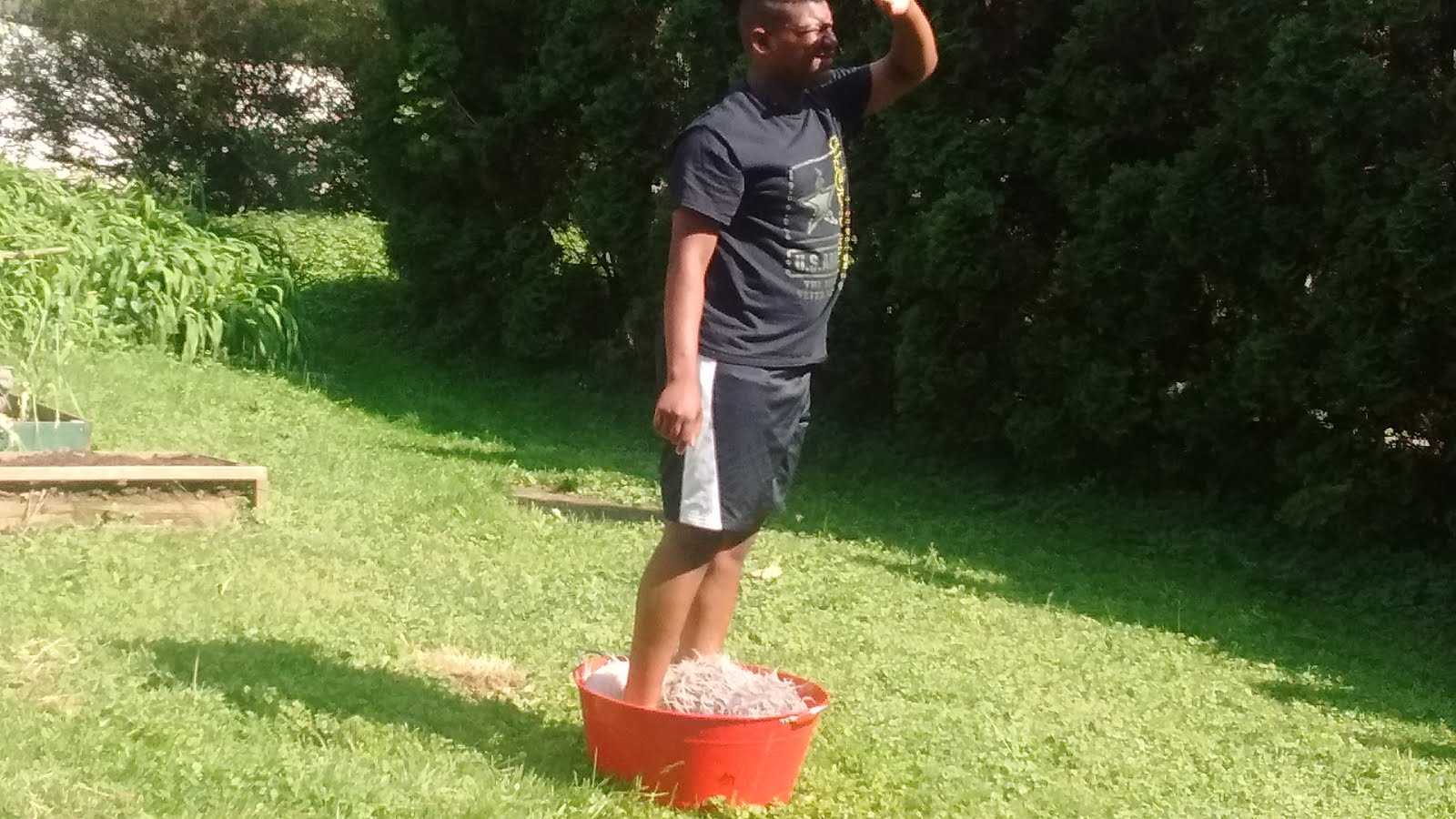
First, fill the tub up halfway.  Don't worry that the big tub isn't quite as big as Big Dog.  Add laundry detergent.


Next, mush Big Dog into the tub, spraying the dog as needed to soak it all the way through.  As the dog gets wet, it compacts even better.  Do not try this with live dogs!  Doesn't work!

Also, don't jump up and down on a live dog!  But Big Dog seemed to get cleaner and less smelly with a bit of large muscle work. This is a happy chore for a teenage boy, and Big Dog doesn't mind one bit.

See?? Big Dog is happy to be curled up in the tub.  I totally love this picture.

And afterwards, rinse Big Dog and then leave Big Dog out on a fence panel/pallet to dry for a couple of days, turning the dog over every once in a while to air out.

Here's Big Dog with a 5-gallon bucket, just to show size.

So clean!  So fluffy!  And not stinky any more.

******

What does this have to do with being a Miser Mom?  My husband, when he started worrying about the smelliness of Big Dog, suggested we get rid of the beast, since cleaning it in our washer just wasn't feasible.  Earlier, he'd suggested the same thing about a heavy cloth floor mat.  Both of these were fairly easy to clean outdoors in a giant tub, sunshine, and fresh air.

And for kids, hand washing (or even foot washing!) their stuffed animals during the summer might be another fun activity to keep kids busy and productive, as well as entertained.  

Monday, May 2, 2016

frugality vs. convenience

My friend Beth confided, a bit sheepishly, the difficulty she has living a low-trash life in this modern world.  She told me she sort of admires me from afar, but has a lot of trouble figuring out how she might reduce garbage in her own life.  She said, "I'd really like to make less trash, but it all comes down to convenience.  It's just, you go to the store, and there are so many other things you have to be doing, and . . . convenience wins".  She sounded kind of embarrassed about admitting this, like it's some kind of guilty secret.

But what she's saying, I understand: grabbing a single box of cereal (with its lovely plastic liner bag) and a carton of milk (whose carton goes into the recycling bin) seems a lot easier than wandering many aisles and buying the many ingredients that come with making your own breakfast in a low-trash way -- not to mention that you still have to actually spend time making breakfast.  How could frugality trump convenience?

To me, all of this "convenience" has a lot of hassle built in that has become invisible to most people.  Beth (and most other normal people I know) assume that going to grocery stores over and over again is convenient.  How do you give that up for frugal DIY-ness?  But for me, the more I get into my weird lifestyle, the more I see massive inconvenience of the grocery-store kind of life.  The parking lots of grocery stores are unkind expanses of asphalt and obstacles.  The stores themselves are full of glaring lights, insipid music, and advertisements.  The sheer quantity and variety of items for sale (do we really need 87 varieties of potato chips?) means that finding the few things you do actually want is slow and inefficient.   (Seriously, grocery store aisles are almost as bad as TSA lines in airports, as far as I'm concerned).  And the checkout lines can vary in speed so much that the comedian Emo Philips uses them as a metaphor for "eternity".

Here's a different version of "convenience".  Last year, I only went to a grocery store (the kind that Beth means) a dozen times, and four of those times were while I was traveling and used a grocery store instead of a restaurant.  So, in 2015 I only made eight trips from home to a grocery store.

Instead, I go about three times a year to Miller's Amish market,
Trash from my last trip to Miller's, several months ago,
next to a canning jar solar light (not trash).
each time stocking up: about 50 pounds of flour, 25 pounds of oats, sugar, dried beans, nuts, some dried fruit.  I buy giant blocks of local, organic cheese for half the price of industrial grocery store cheese.  All of these food things come either in plastic bags (which I reuse for other food storage) or in large brown paper bags, which I recycle with cardboard or use as garden liners; I store the dry goods in large cat litter bins or glass jars to protect them from bugs and moisture.  I cut the cheese (heh heh) into pound size blocks, wrap the blocks individually, and freeze them.  That way, when I want baking supplies in between my trips to Miller's, I go "shopping in the basement" on "in the chest freezer".

My market backpack, with the containers
I'll return to get refills.
I also do a weekly trip to our local farmer's market to get yogurt, eggs, and milk (all in reusable containers, so the only trash is the plastic seal on the yogurt lid and the milk lid).  Compared to the grocery store, our farmer's market is an amazingly human experience, and it's also faster:  from the time I take my bike down off the hook at home to the time I hang it back up again with my groceries in my backpack, is a half hour.  (I've discovered to my surprise that biking is even faster than driving, sitting in traffic, parking, etc).

And when I'm at home, how do I make breakfast quickly?  I've written elsewhere about making waffles and muffins quickly for our weekend breakfasts.  On weekdays, I tend to have homemade granola mixed with yogurt.  I make my granola in large batches (one to two gallons at a time), so the cooking part of that comes only about once a month, usually while I'm making something else.  A gallon jar of granola compared to a wimpy little box of cereal?  To me, the granola scores big on the convenience scale.

Granola is super easy to make.  The more I make it, the more I realize the main ingredients are oats and oil.  Powdered milk, cinnamon or ginger, and sugar add flavor and/or sweetness, but they're totally secondary.  (I get oil and powdered milk at the grocery store, but I'm hoping someday to find bulk versions elsewhere.   Cinnamon and ginger are MUCH cheaper at market than at the grocery store; plus you can bring your own container and refill it there instead of doing trash).
Great Jars of Granola!

The basic idea behind this kind of shopping comes from Amy Dacyzyn's "Pantry Principle"-- keeping a well-stocked pantry that allows me to make a variety of foods (bread/pretzels/granola/muffins/waffles/etc) can be cheaper and faster than choosing the menu first and the ingredients second.

The point of all this description isn't to say that Beth is wrong and I'm right:  I'm sure that Beth would find my version of shopping incredibly inconvenient if she tried to start it up right now.  "Convenience" is a psychological thing; it's much more convenient to rely on habit and routine than to keep trying new things.  I used to go the grocery store weekly or more, and back then I thought that side trips to our farmer's market were a painful extra excursion.  Reorganizing my life took a long time, a lot of experimenting (not always successful).  Now that I'm used to this new way of living, I realize that it has become easy for me (and, in fact, easier than my former habits).  I'm not saying it'd be the kind of life that everyone would like.

But it *is* a life that, now that I'm used to it, means that frugality and low-trash-ity has become *more* convenient, not *less* convenient, than buying packaged and processed food from the grocery store.