Monday, June 1, 2015

update on People-Colored Clothing

Two summers ago, I decided to try to declutter my clothing collection in an unusual way:  I decided to keep only a few sets of colors of clothes.  In August of 2013, I wrote these words.
So here was my rule. I would toss all my clothes, EXCEPT for clothes I like in these three categories:
  1. Black clothes, white clothes, black-and-white clothes.
  2. Brown clothes, yellow clothes, (segued to include some hot-pink clothes).
  3. Personally meaningful clothes.
The third category let me keep, for example, the blue Jackie-Kennedy-esque dress that my grandmother made for my mom. I admit there's a bunch of wiggle room in category 3, but I don't think I abused it.
I realized after I'd cleaned out my closets that I'd pretty much chosen "people-colored clothing."   I wasn't sure whether I'd find the rule overly constrictive (Debbie M. said she could never live this way, which I completely understand), or whether instead I'd find it freeing (one of the Grumpy twins told me that she lives happily on only one basic color of clothes, which I could sort of envision, but not really). Well, now I've had two years to live with color-restricted clothing, and I have to say it's actually been kind of nice.

Lately, I've been realizing just how helpful (and even how much fun) this self-restriction has been.  For one thing, I've been doing a bunch of traveling, giving math talks here and there, and each time I pack my suitcase, I pack light by choosing only sets of clothes that match.  That's a whole lot easier to do when I only have a small set of color choices to choose from:  Will I dress in black, white, and gray?  Or do I pack my  browns and yellows?

Because of my travel scarf, I've increasingly been going with browns and yellows.

Rozy describes a "pashmina" -- a wool version of a scarf.  Mine is a cotton beach wrap that my sister got for me years ago.  It's light enough that it can tie up like a scarf, . . .
 . . . but large enough that I can wrap it around myself like a shawl or blanket in cold airports and cold committee meeting rooms.  (Why do hotels chill their meeting rooms so much!?!)
Plus, it's sort of pretty.  

This spring, I keep reading bloggers who've been sucked into the giant vortex of "The Life Changing magic of Tidying Up".  Although I'm not sure I'd agree with the book myself, I've always admired people who go to extremes -- if only because their uber-extreme-ness gives me a chance to defend my own moderate extremeness by pointing at how much nuttier they are than I am.  To wit: I love love love, but do not want, to fold my socks so they stand up in the drawer.  Totally amazing.  Thank you, Erica!

Still, having enjoyed my three-category clothing experiment, I decided it was time to take it one step further and get rid of the blacks and grays in my drawers.  Here's what my drawers look like now.

Lest you mistakenly think I've become a Marie Kondo clothes folding convert, I'll point out that I'm really of the "roll clothes into cylinders and mush them together" camp.  My clothes are all visible, but not crisp and neat.

The current criteria is that my clothes -- with the odd exception of these hot pink shirts that just keep elbowing their way back into my drawers -- all match my travel scarf.  Now anything I pull out of my drawers will match.  Sort of.

My mom had a 1950's cookbook on our shelf growing up called "To the Bride".  It had remarkably (unintentionally) funny and dated advice.  One of my favorites was, "The cookie jar is the most important part of the kitchen.  You can either purchase a cookie jar to match your kitchen, or you can design your kitchen around the cookie jar".   As for me, I've designed my current wardrobe around a beach wrap.

If I decide in the coming months that I hate this restriction, all I have to do is enjoy my usual summer open-air entertainment (yard sales) and restock my closets and drawers with other colors.   But for now, I'm having fun having even fewer clothes, but more chances of successful and quirky combinations, than before.  

Saturday, May 30, 2015

K-daughter's homemade baby wipes

Here's a little guest posting that I cobbled together from a text message and two emails that K-daughter sent me.  What I love about these letters is not just that she figured out how to make inexpensive baby wipes, but that she's obviously inherited so much of the Miser Mom joy at learning to do things cheaply and frugally.  For joy, just check out all those exclamation points. (!!!)  For frugality, notice she cares not only about things that make a direct difference to her personally (cost), but also to the world around her (plastic, disposable paper).   And notice also that she has totally mastered the art of adapting recipes to use what she's got on hand.   I'm so proud.
And, of course, what warms my heart most of all is that when she's excited to the point of overflowing about this, the person she tells about this is me.  I'm so glad K-daughter is part of my life.

********

I've decided to make my own baby wipes!! So excited!!! :D So, I plan to use cloth diapers, make my own baby wipes and food. I am feeling pretty awesome.
Despite the ingredients being in plastic containers- I think you might enjoy this recipe! Also, I will make some to leave there for Baby A!

The recipe called for 1 bounty paper towel cut in half, 1 tbs of castile soap, 1 tbs of pure aloe, 1tbs of witch hazel, 1 3/4 cup of warm water and 10 drops of any essential oil (for fragrance) and 1 tps of olive oil.

Well, I didn't have castile, so I looked up alternatives- found that I could replace it with a different oil, I chose coconut oil; not only replaces the castile, but I now do not need to use olive oil either! 

MY recipe goes as follows- 
  • one bounty paper towel (according to the woman who experimented with this, bounty worked best, though any paper towel could work. Yes, sorry, paper towel) 
  • 1tbs witch hazel, 
  • 1 tbs aloe, 
  • 1 tbs coconut oil and 
  • two cups of warm water.


Place the paper towel in the coffee can and pour the mixed ingredients over. Place the lid on top and turn over. Let it soak. Pull the paper towel roll from out of the center- this will start the first wipe!

I didn't have a lid that didn't have a hole in it (this one was originally used to store bags) so I place something inside it to seal it. (we can't find our duct tape or I would've used that to cover it).   So next time, I will make sure I have a better lid for it. 


Leaves your hands as.... Well, smooth as a babies bottom ;)

The bounty paper towel was $1.89, the aloe and the witch hazel together was $4 and the coconut oil (that i already had) was once $4. But the paper towel makes 188 wipes (which usually cost like, $7/$8) but since the ingredients makes more than just one pack, its much cheaper and more healthy (after looking at the ingredients on the pampers/ huggies labels) . So ultimately, i just need to buy the papertowel- which would leave the 94 wipes only .94 cents per half roll.... . .01 cent per wipe. Most stores, even at the dollar store from what I have experienced, you only get 72 wipes and they are much smaller than the name brand.


Friday, May 29, 2015

Transporting myself to Toronto

On the way from my home town to Toronto this Wednesday, I got stuck in the Philadelphia airport for about eight hours.

Being stuck in airports is a bit of a specialty of mine.  When flights are getting cancelled right and left, I play a secret game I call "Be the most cheerful person in the airport."  I'm freaking-good at this game: someone grumps at their kids, and I make the kids an origami frog.  I win!  Someone else snarls at the ticket agent, and I smile at the agent.  Another win!  Clumps of travelers huff in frustration that the flight got cancelled, and I give thanks that we're safe on the ground instead of plummeting to our death in a plane that got struck by lightening.  Yay!  I win again!  

I have a personal reason for being so cheerful during long layovers:  airports are actually one of my most productive work zones.  As long as I can get away from the television screens and their waah-whah-waah noises, I find that an airport is a perfect mix of stimulation and lack-of-distraction.  I'm away from kids and colleagues, and sometimes I'm even cut off from the internet, so the usual distractions in my life are removed.  But the setting is unfamiliar enough and noisy enough that I'm not inclined to sleep or daydream.  So I get lots of writing and reading done.  An enforced airport layover can be a bit of a blessing in disguise (with non-negligible emphasis on "disguise", of course).
Avoid the TVs!!!!

Bringing along supplies is crucial.  I never expect that the job of the airlines is to entertain me or feed me, so I come prepared with food, with my favorite travel scarf/blanket, with books that I can read and then toss, and with a pile of long-postponed work.

While the East Coast thunderstorms were busy grounding flights in Philly, I got busy in my own way.  I solved a math problem that a former-student-now-colleague wrote for me, and then wrote up a blurb about the problem that we'll get to use in our next book.  I put finishing touches on a talk I'd be giving at the conference I was going to.  I banged out a bunch of emails.  And I even had time to read a few chapters of a book that had been sitting in my suitcase, waiting for the next airport delay.

So it was a lovely coincidence, as I was surrounded by many stressed-out people, sitting in this hugely industrialized, hugely noisy, and hugely commercial place, that I got to re-read Thoreau's On Walden Pond.  That grumpy old curmudgeon, he says I shouldn't have flown to Toronto at all; he says it would have been cheaper just to walk.
One says to me, "I wonder that you do not lay up money; you love to travel; you might take the [train] cars and go to Fitchburg today and see the country."  But I am wiser than that.  I have learned that the swiftest traveler is he that goes afoot.  I say to my friend, Suppose we try who will get there first. The distance is 30 miles; the fare ninety cents.  That is almost a day's wages.  I remember when wages were sixty cents a day for laborers on this very road.  Well, I start now on foot, and get there before night; I have traveled at that rate by the week together. You will in the meanwhile have earned your fare, and then arrive there sometime tomorrow, or possibly this evening, if you are lucky enough to get a job in season.  Instead of going to Fitchburg, you will be working here the greater part of the day.
Travel has gotten somewhat more expensive in absolute terms (the IRS puts driving 30 miles at $17.25 as opposed to 90¢), although less expensive in real terms.  But the relative cheapness of travel means we're inclined to wander farther.  My own trip costs about $500, including airfare and shuttles and such, for a journey of  400 miles each direction.  I'm not inclined to walk 800 miles instead of driving or flying, y'know?

But even if I don't transport myself in the walking sense, I'm happy to transport myself into realms of productivity; I didn't walk my way to Toronto, but I worked my way to Toronto.  Thoreau would not approve; he would have tsk-tsked the whole mass-transit situation.  But he also would have sucked at the Airport-Cheerful game, giving me yet another chance to win a round, leaving me the undisputed, reigning Cheerful Champion of the Philadelphia International Airport.   Game, Set, and Match!


Wednesday, May 27, 2015

When the opposite of a "windfall" isn't a "downfall"

My husband and I are about to earn significantly less money in the upcoming year.  A year ago, my husband went from full-time to part-time employment; as of June 30 this year, he'll be out of a job entirely.  As for me, my upcoming sabbatical has me trading time for money: I'm taking a full-year sabbatical at 3/4 pay.  All told, our income will be less than half of what it was two years ago.

When we were younger (both in the chronological sense and in the financial sense), this year would have been the time to cut back--wherever possible--on our household spending and then turn to the Good Ol' Emergency Fund to supplement the difference.  That's just what we did back in 2000 when my husband was laid off from a job I didn't like much anyway (yay!), and the strategy worked as advertised, tiding us over until my guy found another good job and I got a promotion.

But now that we've matured a bit (again, both chronologically and financially), I think we'll try a different strategy: we're going to cut down on our "invisible spending".  A year from now, I can let you know how this plan goes.

Here's the basic idea behind why we think our "invisible spending" plan will work now, although it wasn't possible before.

During the first dozen or so years of our marriage, my husband and I had a lot of big financial obligations.  We had a mortgage; every once in a while we'd have a car loan; we had private school tuition and "kid bill" obligations for my step-daughters.  These were large expenses; they were non-negotiable; they drove me from being an ordinary, mildly frugal person into the manic, extreme Miser Mom I am today.

I buckled down and cut discretionary spending everywhere I thought I could.  Eventually we paid off our car loans, and then my step-daughters graduated, and so the kid bills ended.  With all of those expenses behind us, we upped our charitable contributions and pumped more money into our mortgage -- so much so, that a few years later, we paid off our mortgage.  We used the new extra money to  up our charitable contributions a notch further, and we started maxing out our 401Ks and 403Bs.  I opened a Roth IRA.  Last year, when we decided to enroll our boys in the Quaker Local School, I set aside a pile of NSF grant money that will cover most of next year's tuition.

What we didn't do was give up our thrifty ways.  Well, okay, I didn't give up my thrifty ways.  I still yard sale, avoid stores, blah blah blah (you know, the usual Miser Mom schtick).  But for all I chide my husband about spending a lot, even he hasn't upped the glam/wow factor in his life, and he's even made voluntary frugal sacrifices -- like agreeing to become a one-car family, where the one car is a beat-up old Prius, at that.

So as we've grown older and older, we've made more and more money, and we've had fewer and fewer expenses.  And instead of allowing the extra money to float around our heads like butterflies or gnats, we've hidden it from ourselves.  We asked our employers to remove gobs of money from our paychecks and send it directly to our retirement accounts.  They send other parcels of money to the United Way.  I write my first check of each month to our church.  There's money that comes out of my credit card each month for World Vision children we've sponsored.  All this is the money we don't even think about: it's our "invisible spending".

Our visible spending will be hard to cut back on -- for me, because there's not much left of it, and for my husband, because it's just hard to not buy things when he's so used to buying them, especially when all his friends and acquaintances buy even more than he does.  And it's possible the boys have some honkin' big expenses on the horizon, too.  So instead we're going to make our invisible money visible:  we'll just stop contributing to our retirement accounts, one year only.

Ignoring retirement savings isn't the transgression it would have been when we were younger.  For one thing, my employer will still contribute a bunch of money, even when I don't.  But even more significantly, we've now got so much money in our retirement accounts that, Market Willing, our savings will likely grow by more than our max contribution amount, even though we ourselves will chuck in exactly $0. And we've got so much money there already, that we're likely to have enough to retire when I'm finally allowed to retire (which is a few years later than I originally thought I was allowed to retire).

If the "retirement backwash" isn't enough to keep us afloat for the year, I suppose we can turn to reducing our charitable giving next.  I've always thought of that as a kind of a financial "safety valve", but there's something deep in me that hates to go there for my own needs.  Charitable giving has always, for me, been a psychological antidote to insatiable need.

So times will be a bit tight, but not as tight as if we'd grown used to spending all our money as soon as we earned it.  It's yet another reason that I give thanks for the Miser Mom lifestyle.


Tuesday, May 26, 2015

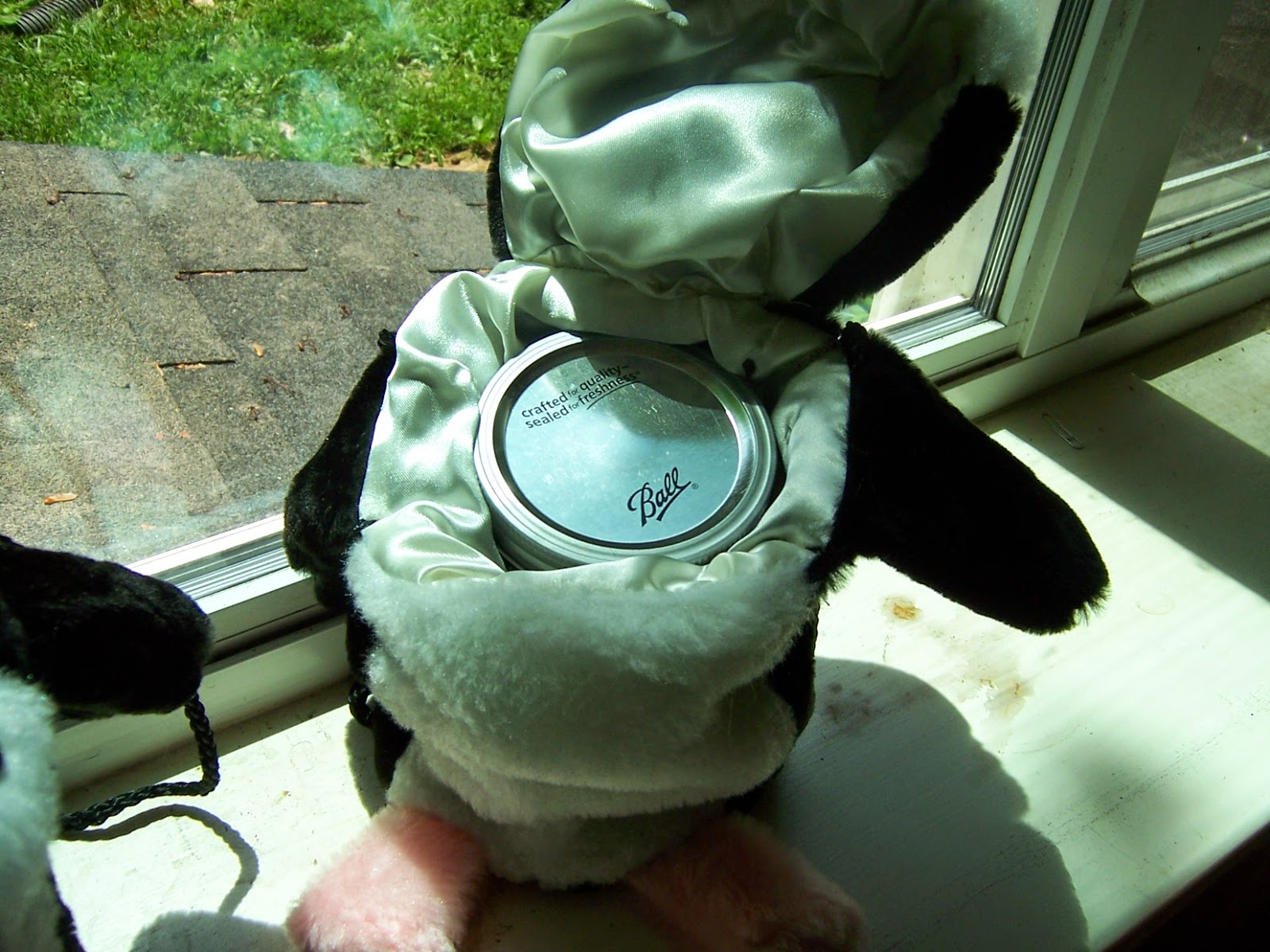
Well, now I can cross "make penguins" off my to-do list

If you happen to have a pair of nieces who both like penguins, and if you also have a bunch of fake fur lying around that you want to make use of before you donate the rest, . . . oh, and if you also happen to want to make lunch bags that can hold quart-sized canning jars . . . well, then this is the post for you.

Here's how to make a Penguin Canning Jar Bag.  First, search the web and find some penguin pictures.  Sketch a design (don't forget the beak, wings, and feet).

Here's the beginning of one head.  Penguins seem to have a white patch around their eyes, with black separating the white.  This is going to be a cylinder -- think of it as a furry penguin-colored headband in the making.


Some animals look cute with really big eyes.  I pulled out my button stash to do some experimenting, and I decided the large buttons would make my penguins look stoned.  So I chose small black buttons for eyes instead.

Here's the beginning of a body, basically a white-and-black cylinder with wings.  I guesstimated the white:black ratio as about 1:2.

In all the pictures I saw, penguins had orange beaks and feet.  Alas, my cache of fake fur didn't contain orange.  I seriously toyed with the idea of green feet and beak, but then I wimped out and went for the pink instead.

Add tops and bottoms to your cylinders, stitch a liner to go inside, throw in some straps, and what do you have?  Penguin bags!  Adorable!

And they hold canning jars!

And if you pick them up by the straps, the penguins lift their wings!

Too much fun.

Monday, May 25, 2015

Curating the past

This past fall, I framed a bunch of old family photos and heirlooms, and I gave them as gifts to my sisters, father, and other relatives.  It was pricey, but it was worth it to pull these treasures out of boxes and make them visible again.

Problem is, there are still more boxes. Still more treasures . . . a lot more treasures.  And maybe there are not enough people to treasure them.  What to do with all these leftovers?


I started inheriting the family memorabilia after I got interested in our history -- like many people, I was enthralled by the 1977 television series Roots, based on Alex Haley's novel.  After that, my grandfather sent me letters he'd written to distant relatives and their responses.  In my young adulthood, I travelled the country collecting stories and memorabilia from our elderly relatives.  Now I have a hand-drawn family tree dating back to the 1700's.  I have photos taken in the year 18-something.  I have giant, 80-year-old books of baby photos.  I have recipes.  I have diplomas and a few clothes and hand-tatted lace and a doctoral dissertation.

It's the kind of collection that everyone in my family thinks ought to be preserved.  As time goes by, though, it becomes clearer and clearer that, this collection, . . . well, . . . , um, everyone else is happy that they are not the ones preserving it.  Life is busy; there's not much time or inclination to sit and read those old, scrawly cursive handwritten letters.  And the photos of these people -- remembering how each of these unfamiliar faces fits into the family, it gets so complicated that looking at the pictures becomes another chore.  These relics reek more and more of ancient history; they feel less and less like the leaves and fruits of a living family tree.

So this collection has become my white elephant:  it's too precious and irreplaceable to toss in the trash, but it's also so unwieldy that nobody actually wants it in their own house.  We need a family library staffed by a family archivist; that's what we need.

Instead, we've got a corner of my sewing room and me.  I want my sewing room back, and I'm getting ready to resign from this job.

So, here's my plan.  Now that I'm on sabbatical, I'm really supposed to be doing my math (and, in fact, my math is what I want to do).  But I'm going to pick one morning each week, and during that morning I'll spend an hour digitizing and making sense of some part of the collection.  I'll transcribe relevant handwritten notes, so they're easier for us all to read.  I'll scan photos and diplomas so we have electronic versions.  I'll write up a family history, including photos and letters in appropriate chapters, so it's easier to tell who fits in where.  With any luck, by December, I'll have a "book" both in digital and in paper form, and that's what the family will be getting for Christmas.

And then, everyone will have one full year to claim anything they want from the collection.  Fair warning, full disclosure.  And if no-one else want this stuff, well, then neither do I.  The originals will all make their way into the recycling bins.

I'd be glad to take advice from other people who've tried similar things in the past.  Anyone?  Anyone?


Thursday, May 21, 2015

Things-to-love-Thursday: the (velcro) ties that bind . . .

It's very, very seldom that I go out of my way to buy something that's made of plastic.  This post shows one of those exceptions (or, more correctly, many of those exceptions): velcro cord ties.
This is 100 velcro ties: 50 new ones for me,
and 50 as a gift for someone I know who likes home organization stuff.

Velcro ties are double-sided strips of velcro with a hole in one end and thin snout at the other end.  The short ones (5" or so) you sometimes find in grocery stores are too short for my taste; I try to find the ones that are at least 7" long.  There are cute little multi-colored versions, but I found these (50 ties for a bit less than $5) at our local hardware store, and I decided that black is beautiful, too.

And yes, for me spending $5 on a package of non-essential plastic stuff is a bit of a guilty splurge.

Here's why I love these ties.  You start with a messy mess of tangly mess that everyone keeps tripping over and tangling up.


Then you strap one of these velcro ties to the cord.  (There's a hole at one end of tie, and you thread the other end through that hole, so the velcro tie doesn't come off accidentally)


Then you coil up the cord, as much or as little as you like, and wrap the free end around the cord.  And . . . beautiful.  Easy to store in a drawer without tangling; easy to leave on the floor without tripping, easy to pack in a suitcase for traveling . . .
Voila!  No more messy mess of tangled mess!

These aren't world-changing.  But I like them.  I like them enough to actually buy them.  True story.