Thursday, November 19, 2015

The Plastic Bag Princess

I think I'm become one of "those people".

You know how, when you go to someone else's house they say something like, "I should warn you:  Don't pay any attention to the mess in my living room"?   Or when you get in someone's car, they apologize for all the stuff they left on the front passenger seat?   Well, when I go to a friend's house, she'll say, "Just don't look at all these plastic bags!"

Really, I try not to judge other people.  Left to my own devices, I am a No-Trash-wanna-be, but in public I try just as hard to follow the Don't-Drive-Them-Crazy rule, especially with people I love. If you have plastic bags in your house, well, it's your house.

That's why I started to feel an existential angst earlier this week when I came home and saw a plastic bag tied to the handle of my front door.  I want so hard to keep those things away from my own home, but this was a plastic bag gifted to me by the Boy Scouts.  And it was for a food drive.  How do I complain about something like that?  And yet: Plastic Trash tied to MY door knob.  Blecccch.

After a few days of letting the existential angst work its angsty way through my system, I decided I did actually want to kvetch, as nicely as I could.  I hunted around on the web, found the "Director of Programs", and wrote him as nice a nasty-gram as I could. My husband shook his head at me:  "You really are becoming one of THOSE people.  The Program Director is just going to hate you, you know."

And yet.  And yet, a mere 15 minutes later, I got back the following letter:
Thank you for your email.  I very much agree about the bags and am going to advocate for a change next year for a number of reasons including those you gave.  I have brought up the prospect of a change in the past and our volunteers who actually run the drive have shot me down.  I will push harder. Again, thank you.
So.  Huh.  That wasn't really as awful and confrontational as I figured it would be.  In fact, we have since exchanged a few more "way to go" emails on the ecological front. 

For what it's worth, I've pasted in the letter I originally wrote below; I modeled it on Bea Johnson's advice to (a) start with warmth and praise, (b) address the specific problem and why it's a problem, (c) offer a viable solution, and (d) return to (a).  

I should warn you it's not the most articulate letter I've ever written.  (I guess I should urge you to just overlook my mess).

*************************
Dear Mr Manner,
I just left this comment on the Food Drive blog, but I wanted to make sure someone in a position of authority gets to see it.  Since you're the Program Director, I hope you are the right person to share this with!
I am not a boy scout (but for many years I was a Girl Scout). I want to thank you very much for the food drive. It’s a wonderful way to help those in need — for example, in my own city, one in four children are food insecure. I know the local food bank really appreciates the extra help you give them! I also think this drive is a wonderful way to teach the scouts about the importance of helping others.
I do have a recommendation to suggest. The plastic bags that you use to request and collect the food detract from the good that you do. When I go out for walks, I see them littering the side of the road where they’ve blown away. Plastic bags are a known source of pollution and environmental hazard (because they’re so light they can be blown far away, and end up endangering sea life, even). For this reason, many locations have banned them from stores.
If your group could switch from plastic bags to paper tags — which people could affix to their own plastic bags, or even tape directly onto boxes of food — this would create a much more ecologically friendly food pickup. (I think that a paper tag would also be much easier to read than the bags, which I have to say, have fairly smudged print.)
Again, thank you for this wonderful service to our community.


Tuesday, November 17, 2015

What's in a purse? (Construction version)

In my last post, I explained that when I made myself a new bag/purse/thing, I decided the main goal was that it would be a helpful transition tool, allowing me to zip effortlessly (hah) from home to office to class to airport. 

It's easiest to describe what I was going for if I explain what I wanted to fix about my old bag that I'd made in 2013.  In many ways, it was a fabulous bag, with lots of dedicated pockets for things I need, and therefore easy to find things in.  I also liked that I could just do a quick pat down -- literally just patting my bag in a few places to make sure I had wallet, phone, keys, planner, and water bottle -- so I didn't have to root around to make sure I was ready to go, once I had my bag in hand.  Here's a quick tour:

 So, what was wrong with this bag?
  • The carrying handles.  I tried to make a "bike" bag, with the shoulder strap coming out of the top and then down around one side, but I very seldom used this on the bike, and so the handle was just sort of . . . awkward.
  • Too-small phone pocket.  I made a dedicated pocket for a flip phone that I owned, but that baby broke and I got a smart phone, which unfortunately didn't fit in the phone pocket anymore.  Dang.
  • Speaking of size, the glasses pocket was large enough to hold my reading glasses, but not large enough to hold my sun glasses.  And my reading glasses would occasionally just fall out.  Which leads to . . 
  • Non-zippered pockets let things fall out.  The pencil holder seemed like a good idea at the time, as did the glasses pocket, but when these are made of upholstery fabric instead of mystery modern materials (like in my older store-bought bag), then ordinary things just slide out.  I lost a lot of pencils and pens, and I also lost a few pairs of reading glasses, before I just gave up and stopped using those pockets.
  • Too-many similar-looking pockets.  Once I started storing my glasses and cell phone in with the things in the existing pockets, it was harder to remember where thing were.  I knew where I kept my often-used things (like keys and cell phone and wallet), but I wasn't sure about my pencil sharpener, bandaids, and other seldom-used items.
  • I grew holes in the bottom of the bag. Okay, I didn't design those in on purpose, but my college gave me a Mac Airbook that is so thin that it doubles as a pizza cutter.  And the corners of this nifty little computer dug little holes into the bottom of my old bag, which I patched and re-patched.  The new bag has a reinforced base in hopes that I won't wound people by allowing my Airbook  to slice through the bottom of my bag and escape in a mad dash to freedom.
In designing a new bag, I cared naturally about price:  because I am, after all, Miser Mom.  I spent about a year scouting out yard sales in the hopes of finding a stash of upholstery (= sturdy) fabric in a color scheme I liked, at a Miser-Mom price.  I lucked out in August and found a yard or two of scraps at my neighbors' house, across the street, for $1.  Meanwhile, I'd been saving zippers and nylon straps out of freebie conference bags and old backpacks.   So I finally had enough raw material for a new bag, and I only had to spend a dollar.

Beyond the cost-to-me frugality aspects of this, I have to say that I also like that this bag is made of scrap material and scavenged accessories, so that making a bag this way is kinder to our landfills and the earth's natural resources, too.  

But really, the main reason I make my own bag is so that it can do exactly what I want. I can't find a bag like this in the store, so the only way to get a bag like this is to make it myself or hire someone else to make it.  And here's what I designed into this bag:

From the outside:  
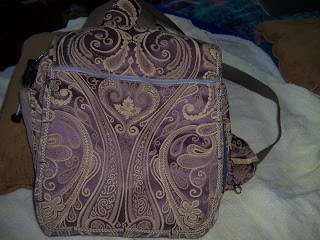
  • Handles, small and large.  This photo shows a small "grab" handle, useful for hanging the bag or picking it up quickly.  You can't quite see -- but it's uber important to me -- that there's a shoulder strap on this, too.  I see a lot of women walking through airports with their hands clutching/carrying their purse, because their purse doesn't have a shoulder strap.  I want to be able to have my hands free when I'm carrying this bag!   [And, as a side note, the strap is long enough that I can actually throw it over my head and one arm, and use it on the bike.  So I really didn't need to do funky straps on the old bag.]
  • Zipper pocket for papers.  The zipper on the front is in a flat flap that covers the rest of the bag.  I pretty much only use this pocket in the airport, when I've got to keep my ID and boarding passes easily accessible.  I also use it to collect receipts while I'm on a trip.  Having this pocket front-and-center is useful when I've got a suitcase and this bag and important papers to juggle.
  • Pocket for my insulated bottle, same as in the last bag.  I love this.

When you pull the flap up and over, you can see a couple of my "pat-down" pockets and hooks.  These are different shapes (so it's easy to remember what goes where), and they're generally larger than in the old-bag-version. 

Here's my own personal set of pat-down items, as shown in the pictures above:
  • On the left is a tall zippered pocket for glasses and/or pencils.  
  • On the right, there's a pocket with an elastic top for my cell phone (the black circle is actually black mesh, so I can see a bit of the screen if the phone is lit up).  
  • Beneath the phone pocket is my money pocket.  
  • And hanging from a nylon strap is a key hook.  
All I have to do is pat-pat-pat and I know I have these important things with me.  As for those seldom-used, but still important things, I've moved them to mesh pockets inside the bag. When I zip down my "special supplies" front panel, there are two large zippered, but see-through (!) pockets.   Unfortunately, I couldn't find a cheap/used source of black mesh, so I had to make do with scrounged white mesh.  Not as aesthetic, but at least the white makes things easier to see.

One pocket contains work/electronic stuff: phone charger cord, the dongle that connects my computer to a projector for when I give talks, a thumb drive.

The other pocket contains "first aid" stuff:  chapstick, swiss-army card (with scissors and tweezers but sans knife because of airport security), a cloth napkin and metal spoon because I try to avoid creating trash when I eat on the road.  

Behind the front pocket, there's a larger pocket that holds the stuff I'm working on/with:  my computer-pizza-slicer of course, and also papers and my planner. That's the pocket that I'm constantly packing and emptying as I leave one place and arrive at the next, so it's nice to keep this stuff separate from the pat-down and seldom-used items that have more permanent residency in my bag.  I like that these go in my bag vertically ("portrait" mode instead of "landscape" mode, if you will).

So far, the bag seems to be working really well for me, where "working well" means getting me out the door quickly and confidently when I need to go from one place to the next.  It's nice having all my seldom-used stuff tucked away securely in the middle of the bag, not interfering with the things I put in and pull out constantly.   The bag is young, so the zippers all work smoothly still, and there are no pizza-cutter holes in the bottom of the bag.  We'll see if we can get this bag to last me six more years until my next sabbatical!


Monday, November 16, 2015

What's in a purse?

So, one of my fun projects this fall has been to make my own [purse].  Actually,  I don't call it a "purse"; but some people I meet call it that (as in, waiters who ask, "would you like a chair to put your purse on?").  Others call it a backpack -- although the thing that I carry around has only one shoulder strap.  If it were more business-esque in appearance, I suppose people might call it a briefcase.  The prototype for this bag was a long-ago purchased thing that the store called a messenger bag or a courier bag. In our family, we call this thing my planner bag.

The reason I'm going on and on about all these names is that the name of the object hints at purpose.  What does a good purse/messenger bag/briefcase look like to me?  That depends on what I'm using it for, of course.

I just finished reading through a friend's copy of The Life-Changing Magic of Tidying Up, and I  was rather amused to see that Marie Kondo classifies these things -- which she calls handbags -- in the category of clothing.  So I suppose I could think of this thing as a fashion accessory . . . which I don't, actually (even though I did choose fabric that could go with most of my outfits).

The word "purse" comes from the Old English pursa, meaning "little bag made of leather" -- I think that's where we got the word "bursar", too.  (In a somewhat related, but weirder etymology, the word "wallet" probably came from germanic roots meaning "roll", because people rolled their money.  Only in the 1800's did a wallet come to mean a flat thing.  Go figure.)  So I could think of this thing as a way to carry my spending money, which in some sense, it is. But of course it's much more than that.  For me, it's so much about organizing my life, that I call it not my "money bag" (purse), but my "planner bag".

But with all the traveling I've been doing lately, not to mention the office-switching that goes with a year on sabbatical, this is the way I've been thinking about my bag lately:  it's a transition tool.

Transitions are tough.  I've gotten to think about this a lot on my many recent travels. Every trip involves packing and unpacking, which is not generally a stress-free activity, even if the trip itself is supposed to be an adventure or a vacation or other stress-releaser.  Making it to the airport, waiting in line at the airport, driving to a new location -- again, not an "ahhh, yesss" kind of feeling for most people.

On a smaller scale, even the daily act of getting out the door in the morning involves a lot of running around on the part of some of my family members.  Just the attempt at, say, trying to leave together for church includes a couple of rounds of "we're going in 5 minutes!" warnings, and even with all those warnings, it still almost always results in one of us urging others, "you just leave:  I'll catch up!"  (It sure is nice that we walk and bike instead of drive, so we can leave separately).  For me, packing up to go to my office usually takes about 10 or 15 minutes of concentrated time:  personal care followed by item-collection.  Hair, shoes, papers, lunch stuff, proper outer clothing.

A good bag helps me with this transition.  I don't use my bag while I'm at home; while I'm in my house, the bag sits in my sewing room or next to my bed. I don't use my bag while I'm working in my office; once I get my computer and papers out, I pretty much work at my desk or with students and leave the bag in the "go home stuff" corner.  But my bag is over my shoulder whenever I'm going from one place to another:  home, office, classroom, store, airport.  If I build my bag right, it helps me move from place to place more easily.

The bag I made a mere two years ago was starting to get holes in the bottom, but even more, I'd designed it thinking I might use it as a bike bag, so it was just poorly designed for my actual daily use.  The combination of a not-entirely-ergonomic bag and the relatively open expanse of time that my sabbatical gives me made this a good time to create a new bag.

Well, that, and I finally managed to find a couple of upholstery swatches at a yard sale for $1.  I'd been waiting on cheap fabric, and it finally came to me.  So, the actual design of the bag, . . . welll that'll come in the next post.

Wednesday, November 11, 2015

My son, the camel

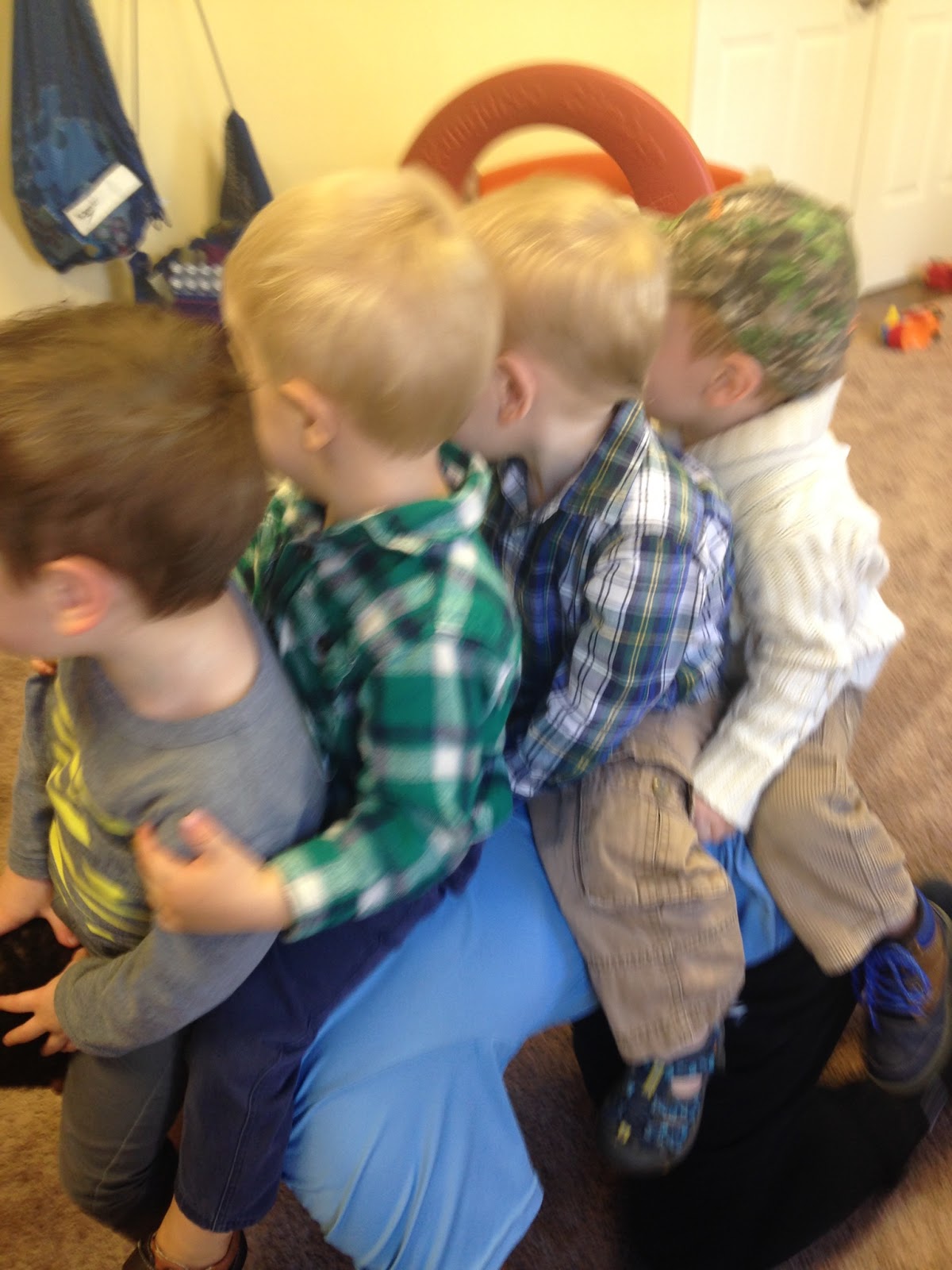
My older son -- J-son -- is a little camera shy at times, but he let the woman in charge of the nursery at church snap this photo of him.  

He's sort of hard to see:  he's wearing a light blue t-shirt and black pants, and the boy in front (the one with the gray t-shirt) has his hands resting on J-son's hair.  Two kids have their legs around J'son's ribs; the front two have their legs hanging over J-son's shoulders.  J-son tells me he was a "camel".  Carrying four toddlers. Isn't that adorable?

This 17-year-old of mine, he's amazingly good with kids.  I think it's partly his upbringing (his pre-Miser-Mom upbringing, I should point out):  J-son spent the first few years of his life in a not-very-healthy home relying more on his siblings than on parents.  Those years were followed by his elementary school years in a much more stable foster home.  His foster mom had a variety of children, almost all of whom needed even more help than J-son did, and so J-son learned a lot about patience and caring for others and being gentle.  He's incredibly good with other people, and really charming.

There are many times in his life when being "incredibly good with other people and really charming" has led J-son into trouble.  In fact, it's part of the reason he's now in the Quaker Local School (our motto:  "better than jail").  But his charm-ability has also been an asset, a joy, and even -- at many times -- a survival mechanism.

It's wonderful to see happy children riding on my son's back.  To see the next generation caring for for the generation that comes even after.  Go, camel, go!

Monday, November 9, 2015

Hope on wheels

Let me put in a plug for one of my favorite vehicles:  a Radio Flyer.  I've been loving my little red wagon for two decades now, and unlike the more expensive four-wheel vehicles I've owned, it requires minimal maintenance.  Pumping up the tires every once in a while, an occasional shot of WD-40 on the metal joints, and a bit of deferred slat-maintenance is all I've ever had to do to keep this workhorse operating smoothly.
Rumors has it, this was Amish-made.  It needs a few slat repairs,
but aside from that it's still in excellent condition.

I love this wagon so much that about a decade ago I bought four sturdy metal garden carts (like the one below) for the college where I work; these green garden carts are invaluable help during orientation and during our annual college yard sale.  I store the carts in my garage between yard sales, and I maintain them as best I can, so I get to use them for heavy-duty hauling on occasion.
The sides come off for carting around really big loads,
but they go back on again easily if I carry smaller boxes & bags.
The main reason I love carts and wagons is that they're great for hauling stuff.  Here's a recent example: I decided I wanted to move a piece of large furniture from my home to my daughter's home, a half-mile away.  It's a cedar Hope Chest my dad made me when I was in my teens.  It's so large, it barely fits through doors, and it definitely won't fit in our car.  But it fits on top of a garden cart, and with the help of my sons, moving was . . . it was a stroll in the park.

J-son didn't want me to take his photo,
so here's a photo of my shadow pulling and his shadow pushing.

On this lovely fall day, I had my sons walk beside the chest to balance the load and to help push if we were going up hill.
N-son is happy to get his photo taken as he pushes while I pull.
And this heavy piece of furniture, once it's on wheels, is so easy to move that one person could do it by himself, as N-son demonstrates below.  GoooOOO, N-son!

Friday, November 6, 2015

A monster ate my friend!!!

A sleeping-bag monster ate my friend.

And it ate her child, too!

The friend/colleague I'm staying with happens to be a fabulous artist in her spare time (whatever "spare time" means to a mathematician and parent).  I love the way she's made crawl-into-me spaces for her kid all over the house.  The monster sleeping bag is just one of these great creative spaces.  There's also a fabulous cardboard box store/house/building, with windows, a door, a paper-shingled roof, and lots of room for coloring on.
 And in the bedroom, there's a club house built from tomato trellises and fabric, with room enough for a grown-up to tuck in alongside the child for tea and for those Very Important Construction Projects.

Don't you just want to crawl inside, too?

Wednesday, November 4, 2015

transitions and travel

I'm on a week-long trip, visiting a colleague and friend of mine.  In the swirl of everything that's happening on this visit (lots and lots of good math conversations, catching up on family stuff, more good meals than I ought to be eating), what strikes me is how much of what takes my energy and thought is what happens in the corners, not in the core, of this visit.

That is, it's not the swirl of math/friends/food/talks that makes me go lie down and recover my brain juice; it's the transitions.  Things like packing.

My friend has a beautiful house, overlooking a gorgeous set of woods. Here is the view looking away from her back deck . . .
. . . and looking back to her house.

But we've spent at least an hour each day with views that look like this.

Uff.  I'm not used to daily commuting, and all this time back and forth in a car is wigging me out just a little.  My friend even drove her daughter to her trick-or-treating night.  

It's making me re-appreciate how nice it is to live in a place that -- even though there's no cedar grove outside my back door, there are neighbors and bike-friendly roads and play grounds and things to walk to.  

But I am doing my best to appreciate the views that I can't get at home, because I don't want to let the corners take over the middle of my experience.  So I retreat from the transitions and look out the back porch and listen to the coyotes yowl.   And then I come in and we do math.  It's good to be here for a while.